Showing posts with label television. Show all posts

Monday, 5 March 2012

There Is no Such Thing as Coincidence: Fictional Plot and Verisimilitude

I am currently enjoying Swedish state television SVT's big science fiction venture Äkta människor (Eng. Real Humans) and would like to urge any and all Swedish readers who have missed out thus far to catch up via SVT Play. International readers should definitely keep an eye out for the series, because I would argue that chances are good that this will be exported. It is an excellent take on an alternate reality / near future, where hubots (i.e. humanoid robots) have become an integrated commodity on the market and in society, yet where both ideological resistance against machines replacing real humans and questions of what constitutes actual humanity and intelligence exist side by side, and in opposition to a smooth integration. Through make-up and superb acting, another reality is projected unto the screen and the result is quite possibly Swedish television's finest hour in a loooooong time.


However, fond as I am of the series after its first eight (out of ten) episodes, there is one thing that has started to bug me somewhat as the plot is slowly gaining its momentum: the nature of coincidence.

There is an old adage that knowingly states that there is no such thing as coincidence. While I am not necessarily ready to subscribe to such a notion completely (if for no other reason than the fact that we would have to define coincidence in a pretty precise fashion), I am willing to agree that there is not really any such thing as coincidence in a fictional plot.

Do not get me wrong: there is clearly a possibility of real world coincidences influencing authors or artists in their narrative choices (in film or television this would furthermore seem even more true as casting choices or even weather conditions on a shooting day might affect the finished product). However, that being said, the nature of plot itself is to create a believable sequence of events, or a mesh of intricate plot strands that unite in a complex yet unified story. Reality may very well be quite disorganised, but a narrative requires a certain sense of order, let us call it narrative logic, to be believable. This line of reasoning obviously resonates in the old Chekov quote about a gun on the wall in the first act of a play needing to be used in the second. In short, a reader will only tolerate so many red herrings, and even then they need to be relevant herrings.

As such, plot is its own enemy, because in trying to create this narrative logic and impose verisimilitude, it also runs the risk of violating the same verisimilitude it tries to achieve. We may not accept the disorganised chaos of reality as narrative proper, but nor do we accept the too neat narrative as real. And this is where coincidence becomes relevant.

Chekov's example above is good because it shows that stories should avoid being bogged down with needless things. Just because an author has a whole world at his disposal, it does not necessarily mean that going anywhere and everywhere in it is beneficial. In fact, and following Chekov's logic, authors need to restrain themselves and only go where their plot needs them to go. The trick is to follow that logic while masking its blatant intentionality.

If every piece and part of a narrative services the plot and the story, it needs to do so without calling attention to the plot or the story (unless it is a case of metafiction, where such a tactic may be suitable). What do I mean? Well, if coincidences are starting to stack up (e.g. chance meetings between characters, deus ex machina type scenarios where there are just enough guns on the relevant wall at the much needed time, etc), we as an audience are less likely to believe that they are coincidences, and we inevitably start sensing the intentionality of plot. It is not that we normally are entirely unaware of the fact that there is a plot, nor even that we do not look for it; it is more a case of a plot suddenly staring us in the face or in other ways calling attention to itself as a plot.

So why do I feel the urge to discuss this in connection with Äkta människor then? Well, the series and its creators have done a fine job of creating an alternative reality or near future, and do an impressive job selling it to the viewer. Verisimilitude is high in this series, to be sure. Yet then there is a nagging sensation, which grows the further into the story we go, that all of our characters (several, but still fairly limited) are interconnected on far too many levels. In this sense, it becomes less an interconnected weave á la Altman's Short Cuts or Haggis' Crash, and much more of an everyone crossing paths with everyone else. The effect, quite naturally, is the sensation of a shrinking fictional reality, where the intentionality of plot is starting to be visible at the seams.

Still, I would not want to end on too harsh a note, because (as stated) this really is SVT's finest hour in a long time. And it bodes well for the future of Swedish science fiction.

Monday, 25 April 2011

A Feature Film Is Not the Equivalent of a Novel

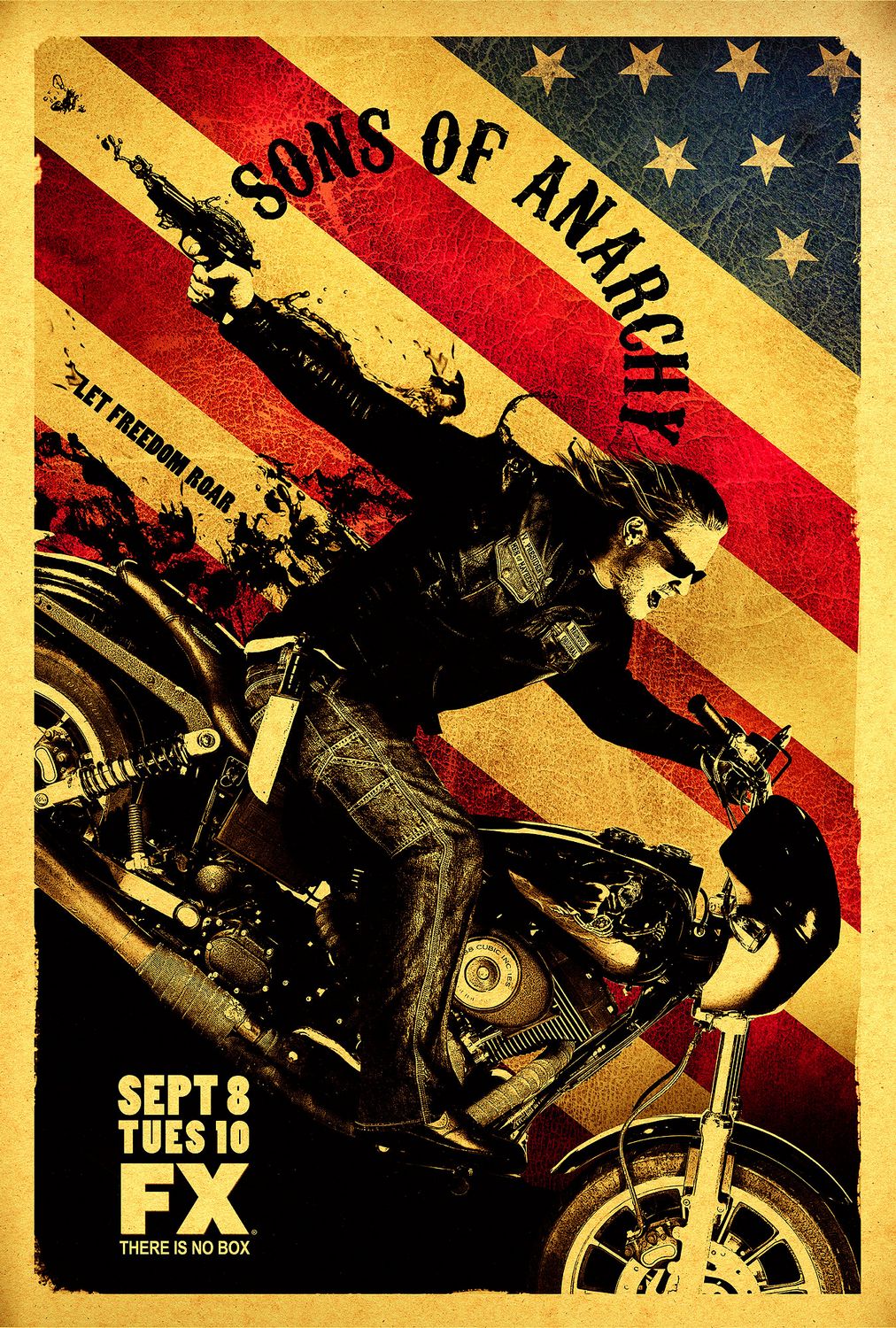
The other day, I finished watching the second season of Sons of Anarchy, and I was yet again reminded of something, which I have often thought during the last decade (and in all honesty, other minds have presented the same idea or similar ones): the cinematic equivalent to a novel is not a feature-length film, but a TV-series. The aforementioned Sons of Anarchy is a clear example of this, as is the absolutely superb series The Wire. But how? And what do I mean when I write this? Perhaps even more importantly, what does this imply for the visual medium of moving pictures?

Relax. I will explain myself.

Let us first remember the distinction between series and serial (which I have discussed earlier) and remember the fact (as also mentioned) that the TV-series format has slowly moved from a more series structured thinking to a more serial structured one. As in most cases, there is not a sharp dividing line; there is room for series with some serial elements, to be sure. However, that is not to say that clearly distinguished specimens of both categories cannot be found without any problems. For all the shades of grey, there are still black and white on the spectrum too, and the distinctions are therefore useful both in b/w terms and on a shaded scale (where the shades can still be judged in the present ratio of either category in any given case).

Given that the format has moved in this direction, it is perhaps not strange that full-blown TV-"serials" (outside of the already existing mini-series format) have proven themselves successful. But how does this relate to my claim? A novel tends to use a different pacing than a feature film. It is (usually) divided into an unset number of chapters, a feature which shapes the narrative, both in practical terms of how readers tend to interact with the text (chapter breaks often being preferred points of pauses in the reading for many readers) and in terms of dramaturgy. By the latter, I mean that chapters as a general rule are structural devices on the writer's part to create narrative units of drama that in some sense almost hologrammatically* mirror the whole. At least on a general level. Chapters often have an internal build-up, not rarely ending with a cliffhanger of sorts, which drives the reading ever onwards.

Now, feature films clearly do not lack dramaturgy and they are often, dramaturgically speaking, divided into acts (which at least on some level can be compared to chapters; this being something of a simplification of a much more complex relation, of course). Nevertheless, feature films are relatively short and definitely meant for single sitting consumption. Novels can be, but certainly need not (and in more cases than not pushes the possibility for such consumption for most readers).

In a TV-series (or -"serial" if you will), each episode serves as a dramaturgically structured unit in a larger dramaturgical structure. That is to say, each episodes functions like a chapter in a novel. Now, a feature film cannot go on hours and hours and hours on end. And yes, I am aware that some films do, but they really raise the question as to how viewable they actually are, and if, in fact, they actually resort to a somewhat episodic structure anyway, and in some sense then mimic novel/TV-"serial" structure. Still, as a general rule films over the three-hour mark are fairly rare on the whole, and many if not most tend to find them rather bothersome to watch for obvious reasons. TV-"serials" on the other hand can easily go on for hours and hours and hours and... simply because they, unlike feature films, do not go on on end. They come with ready-made pauses, where we can catch our breaths and stop for a bit to digest what has been going on. As with a novel, we can read/view one chapter/episode at a time, or as many as we happen to have time for at any given time.

Even more importantly, this less temporally compact structure allows for slower pacing, additional subplots and greater complexities on the whole. I have discussed adaptation in here before, and this certainly has bearing on it. The medium of film has always enjoyed adapting literature, but it is worthwhile noting that slimmer novels, novellas or even short fiction often make for better films. Or at least better adaptations. Simply because the ratio between story content/plot and narrative length is more even and requires less chopping off, cutting or slimming down. Naturally the line is neither singular nor sharp, at least not in terms of page count vs. playing time. After all, a thick tome spending most of its pages on visual descriptions which a camera can capture with a single image stands a much better chance of remaining intact and on time than an equally thick tome where the bulk of the pages is spent to delineate and develop a heavily complex intrigue.

Differently put, TV-"serials" not only have more time in which to tell the story, more space in which to include more story content, but also the opportunity to pace the storytelling differently, to allow for more characters and character voices to be heard, to be (in some sense at least) in focus. There is time and room for a narrative to breathe, to develop over time, and to consequently (at least potentially) hit you even harder with its moments of emotional impact.

There is no doubt in my mind that Alan Moore and Dave Gibbons' Watchmen would have made a much better TV-"serial" than a feature film. I have my reservations towards certain things in the film adaptation (some of which I may well discuss in here at some point), but my main complaint is still that even the good bits did not get time enough to breathe, were not allowed to develop and expand, but rather ended up feeling rushed (and consequently less than satisfactory). Consider the time Rorschach spends with the shrink and the slow revelation that one issue (or chapter, if you will) builds up towards, its heavy impact, and compare to the swift rush job of the film. In a TV-"serial" that would easily have been an episode in its own right. And a mighty fine one at that, if we would have had Jackie Earl Haley still doing the role.

As I write this, I have not yet had a chance to watch the TV-"serial" adaptation of George R. R. Martin's A Game of Thrones (I have watched and enjoyed the 15 minutes preview available on the HBO website), but it certainly looks promising. And it bodes well, if we are seeing the beginning of a trend that will see more adaptations from novels into moving pictures that are not feature films but TV-"serials".


* Holograms are among other things known for the fact that each piece contains the whole.

Monday, 11 April 2011

Who Will Actually Know How to Change the Batteries When They Run Out?

A friend of mine recently said that her children will be computer whizzkids more or less by default, and I questioned this notion. Do not get me wrong. It is not as if I question the ability of my friends children to actually become computer whizzkids. They are still very young and have a lot of time to develop such skills in time. What I questioned was the belief that these skills will be more or less inherent in this generation of children. And this belief is more common than one would honestly wish.

The argument relies on the fact that we live in a society where computers are all around us and that everyone, from an early age (and for better or worse), is forced to interact with this technology on a daily basis. This is undeniably a fact in this age of the internet, social media, smartphones, etc, and I certainly will not make any attempts to deny it. What I strongly question is the flawed assumption that simple exposure will computer whizzkids make. And point to the fact that if that is what we believe, maybe we need to redefine our understanding of what a computer whizzkid is.

It is true that the current generation of children will not have (some of their) parents' (not to mention grandparents') fear of using some of these devices and media. Having grown up around them, the children will no doubt see these devices as a natural part of their lives. But having no fear to use a device or medium does not by default mean mastery of said device or medium. In fact, in this specific context, there are gaps. As I hope I will show.

The first gap is this: computers and other devices today (like smartphones) are designed to be user friendly. This is of course a plus, as it makes these media accessible to more people, and as such makes the many fora opening up all the more democratic. Or at the very least the possibility of their being democratic is heightened by the fact that almost anyone can use them, and definitely without an advanced degree in technology or physics. On the downside, there is quite naturally a greater risk that fewer people understand how the technology behind the devices actually work. And this, of course, applies both to hardware and software.

To illustrate this point further, I would like to point to the situation of my own generation. We are the early generation of people exposed to home computers. I had several friends who had Commodore 64 or 128. For my own part, I opted to get a Nintendo, simply for the reason that it was more user friendly when it came to gaming (no real loading times, no winding cassette tapes back and forth – and yes, not only obsolete floppy disks were used in the early stages but also actual cassette tapes). My decision was one of convenience. Yet, while there is no doubt in my mind that my computer-owning friends had their computers for gaming (just as I had my Nintendo), I note with interest that quite a few of them have continued into careers in software programming or computer support.

The key to this is not strange, of course. While I saved a bit of time on loading my games whenever I wanted to play, they gained early insights into the structure and language of computer coding. It is said that necessity is the mother of invention. I would go even further and say that necessity can also be a great motivation for learning. Or differently put: human beings are quite often lazy by nature. If we do not have to know something, chances are that we will not bother about acquiring the knowledge.

This sort of brings us to the second gap I wanted to discuss: we are already a few generations into the supposedly naturally computer savvy homo sapiens computer (if you pardon the expression), yet I have had students who do not know how to use simple functions and tools in word processing programs. And before you make the argument that everyone cannot be expected to know everything everywhere (which is certainly true), one of the core arguments when claiming that young people are more and more universally belonging to a new breed of computer whizzkids is that these people (because of their fearless nature) will be able to find their way on their own, even if they do not have the specifics in their head at the outset. If this was true, how come they stumble on very simple problems like changing font sizes and types, line spacing, adding page numbers, headers and footers? Or use the spellchecker? Quite simply put, the less we need to scratch our way below the surface of things, the less we will bother finding out what is underneath that surface, let alone know and understand how whatever is there actually works.

As the user friendly nature evolves, the average user (albeit quite obviously belonging to a much greater community of users) will know much less about code writing than my childhood friends who did their gaming on computers; will know much less than myself (who would by no means make any claims to be a computer whizzkid), who acquired no knowledge of code writing, but at least some basic understanding of information structures in some operating systems, after years of using computers as tools for word processing and the like.

This problem (and make no mistake, it is a problem) can be compared to an obvious one in the field of car mechanics. When I was a kid, it was not uncommon for people to fix their cars themselves whenever there were car problems. These days it is more or less impossible for an amateur to dive under the hood of a car and fix anything, because of computerised systems, and nuts and bolts that require specialised tools. In short, the further along we have got, the less car users know about how their vehicles work, and more importantly, how to fix them should something break down.

Similarly in computers, the more user friendly and surface oriented they become, the less informed about whatever happens underneath the surface most users will be. And the worse that negative ratio grows, the more hopeless a scenario when something goes awry starts to look.

A while back my internet pal, Zaki Hasan wrote a blog post entitled "The Death of Saturday Morning". The post deals with the technological advances in television broadcasting and recording, which has forever changed the playing field and made Zaki's (and my own) memories of waiting for a show to start (rather than instantly appear at the press of a button, whenever required) somewhat obsolete and incomprehensible to the current generation of children. There is something of an all-consuming id being fostered into the texture of our societal weave in the underlying question of necessity: why wait?

Why wait indeed? I will not pretend that I am not a fan of watching TV-series on DVD, in order to avoid being bound by a TV guide schedule dictating when I can see what and how much of it. But that confession does not deny that there is an inherent problem in a culture that is seemingly developing a greater and greater need for instant gratification, while simultaneously developing technology that insures that we need not acquire "useless" information about how our tools actually work. If we continue on this route, where will we end up?

Or differently put: eventually, who will actually know how to change the batteries when they run out?

Monday, 8 November 2010

The Muppetational Jim Henson and... The Muppet Show

I grew up in an era when there was no internet; when there were no mobile phones (and when those did arrive, they were mobile, but hardly pocket-sized); and, most importantly for this post, when there were only two channels available on television here in Sweden. Neither of which two channels were broadcasting around the clock like the multitude of channels we have nowadays do. Nope, starting late afternoons/early evenings and then keeping at it till perhaps around midnight (not that the end time was of great importance to me back then, of course), that was all the television available to us. Add to this, the simple fact that there were no DVDs (not an all-round availability of VCRs either for that matter) and you might imagine (if you were not there too) that what was on the tube was something to be watched, in most cases.

Case in point, I watched The Muppet Show as a kid. And I do think I liked it. Kind of. I'm sure some of the funny antics with the puppets were amusing to my younger self, but I'm equally certain that a lot of stuff sailed by way over my head. In fact, while some things have stayed with me (as pop cultural references are wont to do), in some other sense I left the Muppets behind me a long time ago. Until fairly recently, that is.

YouTube has over the last few years reintroduced me to the crazy world of the Muppets. For instance, there is this absolutely outstanding Muppets' version of "Bohemian Rhapsody", which cannot but melt the heart of an old Queen fan like yours truly.


Now, don't get me wrong. It is not like I've shunned the brilliance of master puppeteer (or is it perchance puppet maestro) Jim Henson or his oeuvre. I am a big fan of both his TV show The Storyteller (and its follow-up with retellings of Greek Myths) and films like Dark Crystal and Labyrinth. I just haven't spent many thoughts on The Muppet Show since back in the day.

Well, don't let it be said that it is ever too late to repent for one's proverbial sins of neglect. Having had the Queen extravaganza in my head for quite some time (as well as snippets with the Swedish Chef and the "Mahna Mahna" song – the latter of which can be viewed below), I started considering actually buying at the very least the first series of The Muppet Show. Most of all, what probably drove me to this was a growing suspicion that I had been missing out on something; that my memory simply wasn't good enough or too tainted by a child's p.o.v.

Yesterday, I finally acted on this suspicion and added the first series box set to my collection. Thus far I have only had the chance to watch the first two episodes, but it is funny to note that, yes, I did miss a whole lot of stuff way back when, because a whole lot of it wasn't aimed at children. Looking at it now, there is also the aspect of the show as an historical document, allowing us a glimpse into 1976. However, most of all, I cannot help but laud the late Jim Henson for his genius in setting up a rather typical kind of television show of that era in the most atypical way possible.

I am fairly sure I will be returning to this topic again, but in the meantime, there is only one thing I would like to say... Mahna mahna!


Monday, 3 May 2010

Series and Serial: Some Useful Terminology

In my February post "Epic Proportions or Losing Sight of the Scales", I said that I would return to the terms "series" and "serial", and I think it is high time for that discussion now.

I first encountered these distinguishing terms (as such) during my second semester of film studies, almost a decade ago, and I immediately fell in love with their usefulness. It was in a course on television and the discussion was about a shift in the nature of regular sitcoms and crime shows. Traditionally, these types of shows had been series proper, as it were. What I mean by that, or perhaps more adequately what I was taught that term could be used to distinguish, is a collection of stories involving the same character/s and (mostly) the same basic setting, as well. I use the word "collection" here to avoid the word "sequence"; because "sequence" implies a strict chronological order and a (pardon the repetition) sequence of events. A series requires neither.

Don't get me wrong, a series can include some of these elements and some may well have been present already in earlier sitcoms and crime shows (boundaries between different things like these are rarely, if ever, watertight), but the definition itself does not require it. In fact, one of the charms of most series (be they on television, in the cinema or in the worlds of literature and comics) is that you can start anywhere in the collection and then move on to whichever part you happen to fancy next. This is all because the notion of a series – at least in its purest form – also involves an inherent need to maintain a status quo. The illusion of change is promoted over any sense of actual change and characters are not really developing; they are what they are.

The reason for this is, at least partly, that we should easily be able to recognise these characters and never be confused about where they are in their lives or what has happened to them. Each episode or part of the series tells a separate story using the same recognisable characters, and while the stories should in some sense be character-based (or, at the very least, the characters should be made for the specific types of plots the series are telling), they should not be telling an ongoing character story. Because in the strictest sense, a series is not about character development at all. If you want to understand it better, consider TV shows like M*A*S*H or Kojak, or a film series like James Bond. These examples are not really building a sequence of event, nor (generally speaking) do they change much in the character set up.

A serial, on the other hand, is the complete opposite. Its entire purpose is to build a chronological sequence of events (although not necessarily narrated in chronological order, I hasten to add), to create a continuing sequence in which a sense of cause and effect is almost inherent. Needless to say (perhaps), this approach welcomes character development. It is by no means an altogether necessary component (one could have a serial in which ongoing plot development is the key), such development would work well and thrive in this type of framework.

Returning to the discussion of my film class, the argument was that while regular sitcoms and crime shows (like M*A*S*H and Kojak) in their very nature had been series, by the 90s these types of shows started to include more and more elements of serialisation. Friends would be a clear example of a sitcom which did this (it was one that was brought up in our class discussion at the time). Interestingly enough, that particular example also showcases very well why television makers wanted these elements included: it was done to add a sense of ongoing drama.

As a result, (more or less) every episode of Friends (to stick with our example) is viewable on its own terms. Every episode tells its own little funny story (or set of storylines, as it usually is) and is a narrative capsule unto itself – in true series fashion. Yet most episodes also include references and sometimes even sub-plots that build up a bigger story (or perhaps even bigger stories) throughout the show's many seasons. While staying true to the encapsulated narrative formula on one level (always given the viewer a full story, as it were), this show and others like it also gave those viewers who followed them something extra – the added dimension of dramatic continuation and development.

The approach was clearly a success, and when handled well, it is very enjoyable. However, today the pendulum has, in many cases, swung very far indeed towards total serialisation. Don't get me wrong, serialisation is not a thing of evil... but let's just say that I am not quite so sure about ongoing serialisation or (for want of a better word) "everlasting" serialisation.

So what do I mean by this new distinction? Well, consider these examples: Tolkien wrote The Lord of the Rings as a single novel which was then subsequently serialised by his publisher as three books (later giving rise to an ever-expanding wave of serialised writing within the fantasy genre); BBC's (classic) Doctor Who was made as serialised story arcs (in fact, this show could be described as a series of serials, where each serial is more or less functioning as an episode of a series, whereas each episode within an arc is 100% serial in nature – down to cliffhanger endings, etc); Mike W. Barr and Brian Bolland wrote and drew the 12 issues limited maxi series (yes, I know that the term series might seem confusing in this particular context) Camelot 3000, just as the team of Alan Moore and Dave Gibbons gave us their 12 issues limited maxi series Watchmen around the same time. All of these four cases are clearly serials (all of them represent serialised publication or airing), but they are also limited.

A series can be ongoing, perhaps even "everlasting" (and yes, I am fully aware of the inherent hyperbole here), but it allows readers or viewers to leave with a full story (or several for that matter) finished. The serial, however, strictly speaking gives us one story. Yet again, don't get me wrong. I am neither stupid nor naive enough to think that serials cannot include some sub-plots or contain smaller stories within the story (some of which may well be finished before the main story is), but these stories are never the main event. There is a difference between a set of stories (all enjoyable separately) which adds up to a grand epic history when viewed or read together and an ongoing story which includes smaller stories and sub-plots along the way. The difference (at least in my view) lies in the fact that main story in the latter always is the overall story, the ongoing narrative event; whereas in the former, the main story is (always and ever) the story at hand, or the little story, if you will. And that difference is huge.

Because of this difference, a serial more or less needs to be limited. Although the act of serialisation itself necessitates some sense of ongoing storytelling, it cannot be "everlasting". Without a limitation, the story never ends. And while it could be argued that, in life, no story ever truly ends, there is a strong difference between an open-ended narrative and one that is never brought to its conclusion. The latter (to me) suggests to me either laziness on the part of the storyteller or a great fear of losing the audience. So, in the case of "everlasting" serialisation, we are either to accept being treated with laziness (perhaps even indifference) or to be taken hostages (figuratively speaking) by the storyteller/s – without any knowledge of when we will reach the end... or in some cases even if.

Friday, 5 February 2010

Epic Proportions or Losing Sight of the Scales

Recently having finished watching the fourth season of (the new) Doctor Who, I was reminded of a tendency in a lot of contemporary fiction (be it in literature, comics or film) to aim for a "bigger" sense of storytelling — epic storytelling, if you will. Now, I would like to say that I am a fan of the epic; both in its original (and also academic) sense of "narrative" and its more popular sense of "grandiose storytelling". That having been said, however, I would say that I am not a fan of this tendency.

Once more, don't get me wrong. When successful grandiose storytelling occurs, I love it. But there seems to be a mistaken sense of proportion afoot in the field. Because the tendency reveals that that aim for the grandiose and epic more often than not ends up in something smaller.

What am I talking about? I am talking about the tendency in fantasy to write never-ending stories — serials, really — or the tendency in superhero comics to write huge crossover events. One could also mention the move in television, where Doctor Who undeniably fits in, from series to serial (two terms which I will return to in an upcoming post); not always in the purest sense, but more or less.

So, what is the problem then? Quite simply put, size (as so many things) turns out to be relative on many levels. For instance, one of my favourite fantasy writers is Michael Moorcock. His concept of the Multiverse and the many incarnations of the Eternal Champion inhabiting these many realities provide true grandeur to Moorcock's fiction. There is a sense of nigh endlessness in the cosmic scale of things, but at the same time that scale is most often in the background (the weave that binds everything together) whereas the stories equally often are short (or at the very least not overly long). Compare this to all the Jordans, Goodkinds and Martins who never seem to want to finish that one story in pursuit of the grandiose. Tolkien, who somehow is as grandiose in his storytelling as they get, remains more or less unequalled by his imitators; and quite frankly, adding more and more pages simply doesn't seem to be the way to beat his grandeur.

Grandeur is perhaps best felt in that Moorcockian moment of several tales interconnecting, revealing the "world" (as it were) on a large scale – too large, perchance, to be encompassed in a single story.

The same can be said about the event craze of contemporary superhero comics. In the olden days (if you'll pardon the expression), the Marvel universe, for instance, was a big place and there was a lot of big things happening in any given year; alien invasions, evil genii attempting world domination, and life and death situations (all side by side with the smaller street scale adventures of other heroes). All of this worked well, until the notion of telling crossover stories started to spread like wildfire.

Now, there is nothing inherently wrong with crossovers every now and again (or guest appearances), but when at least six months every year seem to be ruled by an Event taking place, first and foremost, in a limited series, which then in crossover fashion involves more or less every single title from the company in this grandiose saga or Event, the world or universe doesn't get bigger; it gets smaller.

How do I mean? Well, before we had a multitude of events in a year, now we more or less have one. It sure brings just about every hero into the story, true. But that only makes the universes these heroes inhabit smaller; simply because less happens.

So, what does this have to do with Doctor Who? And am I saying I didn't like the fourth season?

Let me answer the second question first: I loved the fourth season of Doctor Who. It does, I think, balance its components and its sense of grandeur fairly well. I brought it up, partly because it manages this, but also because I could see the tendency at work towards the end. Comparing it to the old classic Doctor Who shows (which ironically were serials proper, of course), I was struck by the fact that the entire Eccleston and Tennant runs leave fairly little time for extracurricular adventures. In short, in many ways, what we see is what we get. Nothing more, nothing less... but yet again, nothing more!

We seem to want more and more interconnectedness in our storytelling, quite simply put, but it also seems as if many of the people telling us stories misses the point that interconnectedness neither equates a single ongoing story or tying every story together with all the others. Often true grandeur lies in a grander weave of tales — tales in the plural — which interconnect with each other both through the slightest of touch points here and there, and more direct links.