The other day, I finished watching the second season of Sons of Anarchy,  and I was yet again reminded of something, which I have often thought during the last decade (and in all honesty, other minds have presented the same idea or similar ones): the cinematic equivalent to a novel is not a feature-length film, but a TV-series. The aforementioned Sons of Anarchy is a clear example of this, as is the absolutely superb series The Wire. But how? And what do I mean when I write this? Perhaps even more importantly, what does this imply for the visual medium of moving pictures?
Relax. I will explain myself.
 Let us first remember the distinction between series and serial (which I have discussed earlier) and remember the fact (as also mentioned) that the TV-series format has slowly moved from a more series structured thinking to a more serial structured one. As in most cases, there is not a sharp dividing line; there is room for series with some serial elements, to be sure. However, that is not to say that clearly distinguished specimens of both categories cannot be found without any problems. For all the shades of grey, there are still black and white on the spectrum too, and the distinctions are therefore useful both in b/w terms and on a shaded scale (where the shades can still be judged in the present ratio of either category in any given case).
Given that the format has moved in this direction, it is perhaps not strange that full-blown TV-"serials" (outside of the already existing mini-series format) have proven themselves successful. But how does this relate to my claim? A novel tends to use a different pacing than a feature film. It is (usually) divided into an unset number of chapters, a feature which shapes the narrative, both in practical terms of how readers tend to interact with the text (chapter breaks often being preferred points of pauses in the reading for many readers) and in terms of dramaturgy. By the latter, I mean that chapters as a general rule are structural devices on the writer's part to create narrative units of drama that in some sense almost hologrammatically* mirror the whole. At least on a general level. Chapters often have an internal build-up, not rarely ending with a cliffhanger of sorts, which drives the reading ever onwards.
Now, feature films clearly do not lack dramaturgy and they are often, dramaturgically speaking, divided into acts (which at least on some level can be compared to chapters; this being something of a simplification of a much more complex relation, of course). Nevertheless, feature films are relatively short and definitely meant for single sitting consumption. Novels can be, but certainly need not (and in more cases than not pushes the possibility for such consumption for most readers).
In a TV-series (or -"serial" if you will), each episode serves as a dramaturgically structured unit in a larger dramaturgical structure. That is to say, each episodes functions like a chapter in a novel. Now, a feature film cannot go on hours and hours and hours on end. And yes, I am aware that some films do, but they really raise the question as to how viewable they actually are, and if, in fact, they actually resort to a somewhat episodic structure anyway, and in some sense then mimic novel/TV-"serial" structure. Still, as a general rule films over the three-hour mark are fairly rare on the whole, and many if not most tend to find them rather bothersome to watch for obvious reasons. TV-"serials" on the other hand can easily go on for hours and hours and hours and... simply because they, unlike feature films, do not go on on end. They come with ready-made pauses, where we can catch our breaths and stop for a bit to digest what has been going on. As with a novel, we can read/view one chapter/episode at a time, or as many as we happen to have time for at any given time.
Even more importantly, this less temporally compact structure allows for slower pacing, additional subplots and greater complexities on the whole. I have discussed adaptation in here before, and this certainly has bearing on it. The medium of film has always enjoyed adapting literature, but it is worthwhile noting that slimmer novels, novellas or even short fiction often make for better films. Or at least better adaptations. Simply because the ratio between story content/plot and narrative length is more even and requires less chopping off, cutting or slimming down. Naturally the line is neither singular nor sharp, at least not in terms of page count vs. playing time. After all, a thick tome spending most of its pages on visual descriptions which a camera can capture with a single image stands a much better chance of remaining intact and on time than an equally thick tome where the bulk of the pages is spent to delineate and develop a heavily complex intrigue.
Differently put, TV-"serials" not only have more time in which to tell the story, more space in which to include more story content, but also the opportunity to pace the storytelling differently, to allow for more characters and character voices to be heard, to be (in some sense at least) in focus. There is time and room for a narrative to breathe, to develop over time, and to consequently (at least potentially) hit you even harder with its moments of emotional impact.
There is no doubt in my mind that Alan Moore and Dave Gibbons' Watchmen would have made a much better TV-"serial" than a feature film. I have my reservations towards certain things in the film adaptation (some of which I may well discuss in here at some point), but my main complaint is still that even the good bits did not get time enough to breathe, were not allowed to develop and expand, but rather ended up feeling rushed (and consequently less than satisfactory). Consider the time Rorschach spends with the shrink and the slow revelation that one issue (or chapter, if you will) builds up towards, its heavy impact, and compare to the swift rush job of the film. In a TV-"serial" that would easily have been an episode in its own right. And a mighty fine one at that, if we would have had Jackie Earl Haley still doing the role.
 As I write this, I have not yet had a chance to watch the TV-"serial" adaptation of George R. R. Martin's A Game of Thrones (I have watched and enjoyed the 15 minutes preview available on the HBO website), but it certainly looks promising. And it bodes well, if we are seeing the beginning of a trend that will see more adaptations from novels into moving pictures that are not feature films but TV-"serials".
* Holograms are among other things known for the fact that each piece contains the whole.
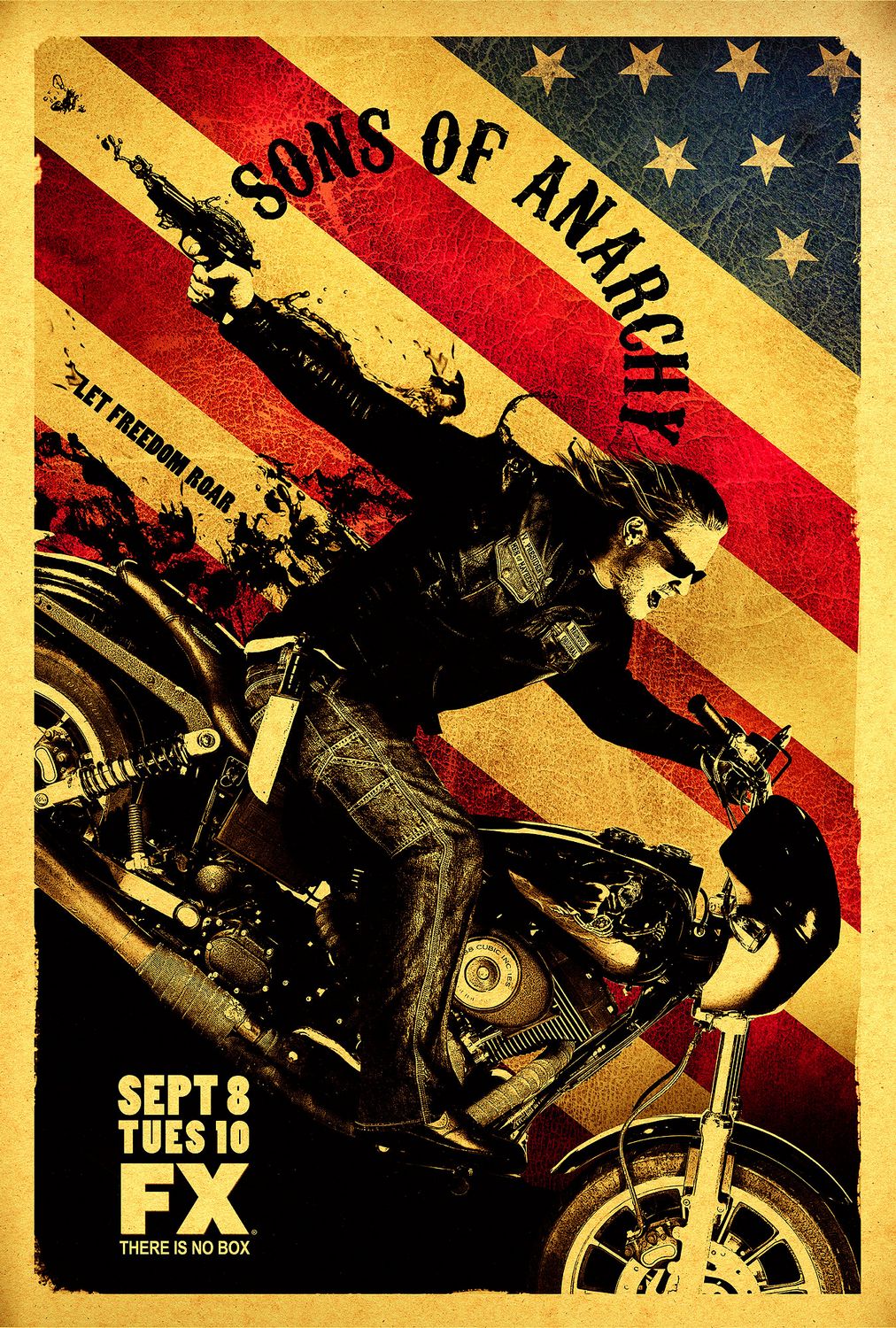 and I was yet again reminded of something, which I have often thought during the last decade (and in all honesty, other minds have presented the same idea or similar ones): the cinematic equivalent to a novel is not a feature-length film, but a TV-series. The aforementioned Sons of Anarchy is a clear example of this, as is the absolutely superb series The Wire. But how? And what do I mean when I write this? Perhaps even more importantly, what does this imply for the visual medium of moving pictures?
Relax. I will explain myself.
 Let us first remember the distinction between series and serial (which I have discussed earlier) and remember the fact (as also mentioned) that the TV-series format has slowly moved from a more series structured thinking to a more serial structured one. As in most cases, there is not a sharp dividing line; there is room for series with some serial elements, to be sure. However, that is not to say that clearly distinguished specimens of both categories cannot be found without any problems. For all the shades of grey, there are still black and white on the spectrum too, and the distinctions are therefore useful both in b/w terms and on a shaded scale (where the shades can still be judged in the present ratio of either category in any given case).
Given that the format has moved in this direction, it is perhaps not strange that full-blown TV-"serials" (outside of the already existing mini-series format) have proven themselves successful. But how does this relate to my claim? A novel tends to use a different pacing than a feature film. It is (usually) divided into an unset number of chapters, a feature which shapes the narrative, both in practical terms of how readers tend to interact with the text (chapter breaks often being preferred points of pauses in the reading for many readers) and in terms of dramaturgy. By the latter, I mean that chapters as a general rule are structural devices on the writer's part to create narrative units of drama that in some sense almost hologrammatically* mirror the whole. At least on a general level. Chapters often have an internal build-up, not rarely ending with a cliffhanger of sorts, which drives the reading ever onwards.
Now, feature films clearly do not lack dramaturgy and they are often, dramaturgically speaking, divided into acts (which at least on some level can be compared to chapters; this being something of a simplification of a much more complex relation, of course). Nevertheless, feature films are relatively short and definitely meant for single sitting consumption. Novels can be, but certainly need not (and in more cases than not pushes the possibility for such consumption for most readers).
In a TV-series (or -"serial" if you will), each episode serves as a dramaturgically structured unit in a larger dramaturgical structure. That is to say, each episodes functions like a chapter in a novel. Now, a feature film cannot go on hours and hours and hours on end. And yes, I am aware that some films do, but they really raise the question as to how viewable they actually are, and if, in fact, they actually resort to a somewhat episodic structure anyway, and in some sense then mimic novel/TV-"serial" structure. Still, as a general rule films over the three-hour mark are fairly rare on the whole, and many if not most tend to find them rather bothersome to watch for obvious reasons. TV-"serials" on the other hand can easily go on for hours and hours and hours and... simply because they, unlike feature films, do not go on on end. They come with ready-made pauses, where we can catch our breaths and stop for a bit to digest what has been going on. As with a novel, we can read/view one chapter/episode at a time, or as many as we happen to have time for at any given time.
Even more importantly, this less temporally compact structure allows for slower pacing, additional subplots and greater complexities on the whole. I have discussed adaptation in here before, and this certainly has bearing on it. The medium of film has always enjoyed adapting literature, but it is worthwhile noting that slimmer novels, novellas or even short fiction often make for better films. Or at least better adaptations. Simply because the ratio between story content/plot and narrative length is more even and requires less chopping off, cutting or slimming down. Naturally the line is neither singular nor sharp, at least not in terms of page count vs. playing time. After all, a thick tome spending most of its pages on visual descriptions which a camera can capture with a single image stands a much better chance of remaining intact and on time than an equally thick tome where the bulk of the pages is spent to delineate and develop a heavily complex intrigue.
Differently put, TV-"serials" not only have more time in which to tell the story, more space in which to include more story content, but also the opportunity to pace the storytelling differently, to allow for more characters and character voices to be heard, to be (in some sense at least) in focus. There is time and room for a narrative to breathe, to develop over time, and to consequently (at least potentially) hit you even harder with its moments of emotional impact.
There is no doubt in my mind that Alan Moore and Dave
 Gibbons' Watchmen would have made a much better TV-"serial" than a feature film. I have my reservations towards certain things in the film adaptation (some of which I may well discuss in here at some point), but my main complaint is still that even the good bits did not get time enough to breathe, were not allowed to develop and expand, but rather ended up feeling rushed (and consequently less than satisfactory). Consider the time Rorschach spends with the shrink and the slow revelation that one issue (or chapter, if you will) builds up towards, its heavy impact, and compare to the swift rush job of the film. In a TV-"serial" that would easily have been an episode in its own right. And a mighty fine one at that, if we would have had Jackie Earl Haley still doing the role.
 As I write this, I have not yet had a chance to watch the TV-"serial" adaptation of George R. R. Martin's A Game of Thrones (I have watched and enjoyed the 15 minutes preview available on the HBO website), but it certainly looks promising. And it bodes well, if we are seeing the beginning of a trend that will see more adaptations from novels into moving pictures that are not feature films but TV-"serials".
* Holograms are among other things known for the fact that each piece contains the whole.


 , or a film series like
  would be a clear example of a sitcom which did this (
 was made as serialised story arcs (
 around the same time. All of these four cases are clearly serials (




 Posts
Posts


