Showing posts with label adaptation. Show all posts

Tuesday, 28 August 2012

Secret Identities, Origin Stories and Never-ending Continuities: On Superhero Films and Some of their Problems

Having seen The Avengers, The Amazing Spider-Man and The Dark Knight Rises this year (liking them all to different degrees), I have been struck by a few things that seem to continuously manifest themselves as the superhero genre has migrated from the four-coloured pages of comicbooks to the silver screen, and problematically so, I would argue.

This post will focus on three things: secret identities, origin stories and never-ending continuities. All of these (mostly) seem to become problematic in the genre's transition from one medium to another.

Let's start off with secret identities. This conceit is central to the superhero genre. It is not that there aren't exceptions (the Fantastic Four leaps to mind, for instance), but most superheroes do have them. And they have them for a reason.

While fans love debating which identity is any given character's "true" identity (e.g. is Superman really Superman sometimes pretending to be Clark Kent, or is he Clark Kent sometimes pretending to be Superman?), the idea of the dual identity is deeply rooted in another idea: that doing what heroes usually do tends to go together with making enemies of the more violent kind, who would just love to know about all the hero's relatives and friends in order to hit him/her where it hurts.

Now, recent superhero films tend to pay a faux tribute to this concept. Sure, Spider-Man is still Peter Parker when Andrew Garfield plays him, but the secretly bit is kind of whittled away. After a while, Garfield is leaping about without mask more than with it, it seemed. And before long, a bundle of other characters know fully well that Peter Parker is Spider-Man. Don't get me wrong: I like Marc Webb's reboot. In some places I think it is superior to the Raimi "trilogy" (e.g. hello mechanical web-shooters!), in others less so. However, among the things I find really off-putting is this failure to grasp the importance of keeping the secret secret.

While The Avengers also fails in this – Tony Stark is publicly Iron Man since the ending of his first film; Captain America is running around without mask as much as with mask (which I'd say is fairly public); Hawkeye has done away with mask altogether (I excuse Black Widow, since she hasn't been masked in the comics since the 60s, I believe); and Thor has done away with a civilian identity altogether – with the exception of the overly maskless Cap (who had a good hood and all), the context makes it work better; consequently, I am more forgiving here.

Secondly, we have origin stories. These stories are crucial to superheroes in that they are the central to the character, a sort of frame for what he/she is and why. However, as such, they are backdrops defining the characters, but not necessarily stories that needs to be told as the main story – front and centre.

I understand that origin stories are tempting when a superhero is adapted to the big screen. After all, it is a central story and possibly the story with which a larger audience is somewhat familiar (if familiar at all). Still, I find the notion that every (yes, I am exaggerating) superhero film has to be an origin story, unless it has a number behind the title (in a manner of speaking), highly annoying. Add to this the recent trend of rebooting every franchise within three films or so (if that), and you not only have a continual stream of origin stories reaching the big screen, but a continual stream of versions of the same origin stories over and over again. Originitis is killing off potentially good stories by repeating till fade.

If you want to see a good example of rebooting, watch Leterrier's The Incredible Hulk. It is clearly a reboot, with a different version of the origin than that presented in the earlier Ang Lee film. The story of Leterrier's film, however, is not that origin story. That story is neatly presented to the viewer in the credits sequence at the opening of the film, basically doing what I mentioned above: it provides a frame for the character. The story that follows is another story, and one I really enjoyed at that.

Part of the problem with originitis is that it blocks the creative process. Not only does many if not most heroes carry with them any number of other classic stories or story arcs that could potentially be adapted into film or drawn upon, there is also a great narrative strength in the fact that these characters as a general rule are constructed to carry continuous stories in unspecified numbers. That is to say, new stories ought easily be folded in and presented, on the big screen just as easily as in a new issue of the comicbook.

Which nicely leads us to the final thing on my agenda, i.e. never-ending continuities. Superheroes are the type of characters who are mythic in nature. In revisiting Raimi's conclusion to his Spider-Man trilogy earlier this year, my friend Zaki Hasan wrote: "I've often heard superhero stories likened to modern mythology as a way, perhaps, to make the former sound more important than they are, but the big difference is that, unlike Robin Hood or King Arthur, there's no Sherwood burial or flight to Avalon for Batman or Superman or their ilk." While this would seem to contradict my preceding statement, I would rather suggest that Zaki here fails to distinguish (quite usefully, I would argue) between myth and legend. Myth carries with it the cloth of mythology, which more than anything is a vast canvas of interrelated character about whom stories upon stories upon stories are told. Compared to the legends of King Arthur or Robin Hood, who more clearly have dramatic arcs, the gods of the Norse men or the Greek were religious stories of continuous example. Basically, the idea of character clearly supersedes that of plot (which is not to say that the latter is altogether insignificant).

Superhero stories belong in this category too. There is not a finite number of Spider-Man tales to be told, but a multitude of possibilities. What is important is the character, and whatever stories he can carry. Any of these stories needs to have a beginning, a middle and an ending (like all stories do), but they need not be the beginning (originitis) or even more importantly the ending of the character.

With this in mind, the current trilogyitis (going hand in hand with the originitis, it seems) only forefronts the issue. Instead of creating an interesting version and allowing others to play with the concept in the same playground – building a cinematic continuity that allows for (if not necessitates) interesting links to be made and stories to intermingle and build upon each other – it appears as if more or less every director wants to mark his/her territory so badly that they pee all over the place.

And it should not be necessary. Marvel Studios has successfully shown that cinematic continuity is not only possible, but a hugely successful concept (I willingly admit that part of me wept a little when I read an interview in which Shane Black, director of Iron Man 3, talked about his film as the concluding part of the trilogy). Whedon's Avengers not only builds upon the preceding films and serves as their culmination; it suggests further stories. Quite possibly an endless supply of stories.

The idea here is not that a (nigh) endless sequence of stories need be told, but rather that any story should suggest itself as part of such a sequence even if the sequence itself never exists.

To give an example, and return to the distinction between myths and legends, or fairy tales, I would like to quickly bring up Tim Burton's two Batman films. Now, I will confess to being a huge Burton fan, and I do like his Batman films, but there are some elements that has never sat right with me. And I pegged what the problem was fairly early on in life: Burton's genre par excellence is the fairy tale. Almost any Burton film corresponds to this literary genre. Now, the fairy tale, much like the legend, is very much plot driven. In fact, the former is probably a bit more so than the latter, since the plots of legends seem more obviously centred on central characters (e.g. King Arthur or Robin Hood), whereas the characters of fairy tale to a much greater degree are more easily reducible to types (e.g. Snow White or Cinderella). In a fairy tale, the beginning, middle and ending are the beginning, the middle and the ending: in a nutshell, the be-all of plot and story.

So where does this leave us with regards to Burton's two Batman films (after all, there are clearly two, which would seem to contradict my point)? Well, fairy tales solve their plot permanently, and quite often violently. Not that superhero stories do not use violence, but mostly death is kept out of the equation (obviously with exceptions). Or if death occurs, the reader usually craves a body (mostly withheld) in order to believe this "death" is in any way permanent. What I am getting at here is the idea of rogues' galleries, of arch enemies, of cycles of enmity and battle. Burton notably kills off both the Joker and the Penguin, removing them from that continuity after their first appearance (in this context, it is worth noting that Nolan did an even greater injustice to Two-Face in The Dark Knight, not even allowing the character a full appearance before removing him). These are two classic arch enemies in Batman's rogues' gallery and to Burton they simply appear expendable at the altar of plot and story, as if a single story is enough not only to characterise these characters or their relationship to the Batman, but also to tell all there is to tell about the characters.

I am reminded of a brilliant little Batman story I read as a teenager back in the late 80s (notably before switching to reading American comics in original). The title, which sadly escapes me in detail, was something with "circles" or "symbols", or similar. The point of it, which has stayed with me, was Batman meeting a gypsy fortune-teller, while searching for the Joker. In her reading of Batman (whether by tarot or crystal ball, I forget), she sees the cyclical nature of the relationship between Batman and the Joker (something which both Frank Miller and Alan Moore respectively touch upon in The Dark Knight Returns and The Killing Joke also). The story was not long, as I recall. I'm not sure if it would have been a full American issue even, but it really nicely pinpointed this phenomenon, which somehow strikes me as a core concept in the genre: the villain always (okay, another exaggeration, but bear with me) returns. And the hero avoids killing the villain, because killing is not what heroes do.

To wrap up, I sincerely hope the trend is turning. I hope that secret identities will become secrets to be kept yet again. I hope that we will get more than just origin stories on repeat. And I hope ever so much that we will get more middles. Middles all the way up, to borrow from an old saying about turtles.

Monday, 12 December 2011

On Adaptation Revisited: Fidelity, Quality and Translation

In the past week, I attended a doctoral colleague's work-in-progress seminar, which touches on one of my interests: adaptation. Now, old readers know that I have written on adaptation in here before (and also on the related question of what constitutes a medium), but the seminar made me think about a few things yet again and it seemed appropriate to revisit the subject.

The seminar once more revealed the seemingly great bogeyman of adaptation studies and theories: the issue of fidelity. For some reason, this issue is deemed very problematic, and has people twisting themselves every which way to avoid it. I cannot help but ask why? In truth, to my mind, the issue is much less problematic than most of these critics and theoreticians seem to think, and I will explain why.

Regardless of what medium one adapts from and to, there is a need to distinguish the process of adaptation from the resulting adaptation. The former is arguably an act of translation, a word which etymologically comes from the Latin translatus, i.e. literally "carried across" (see Merriam-Webster). However, as has been noted many times, the act of translation (whether between languages or media) is never a simple process of transfer, but one that always, without exception, involves change on some level. The etymology of the word "adaptation" ("from Latin adaptare, from ad- + aptare to fit, from aptus apt, fit") is arguably a good indication of this aspect, as the idea that necessary changes occur in the process can be seen as the result of the act of fitting something into a different language or medium, and act of metaphorical tailoring attached to the process of the transfer of content. The resulting adaptation, however, is never just a result of that process; it is also a narrative object in its own right.

So what do I mean with this distinction and why do I stress it? Well, the process of translating anything — whether it is translating a text in Swedish to English, or a narrative in literature to film — implies a given source material that needs to be carried across a void of difference, from one language or medium to another; ultimately being fitted into its new location. As such, fidelity can arguably be seen as the mark of a successful process: Was the material carried across adequately; and was it made to fit its new language or medium?

However, fidelity in itself will never tell us if the resulting narrative object is any good. Arguably, one could conceivably transfer and adapt properly (to use Brian McFarlane's distinctions) more or less everything from the source text into the new object (if you will), but without making that object a good one. Sticking to the classic example of adaptation from literature to film, this would basically mean turning a good book into a faithfully adapted but ultimately poor film.

Please note that I am not saying that faithful adaptation is impossible. I am merely pointing out the rather obvious, yet sometimes quite forgotten truth, that fidelity is not a mark of qualitative narrative. In fact, I think that it is this very forgetfulness that haunts adaptation studies and causes the rather unnatural twists and turns in the discourse in trying to shun notions of fidelity and a source text. It is not that the narrative object to come out of the process is not tied into a web of intertext all its own, but clearly the fact that we talk about it as an adaptation of another text means that one of its intertexts is singled out and heavily emphasised. To pretend otherwise seems to be missing something very fundamental about the process.

Similarly, to merely point out failure to be faithful is equally missing the point. The core question here is rather why than what. This is where formalist theories like McFarlane's is so useful. It allows us to delineate what can be transferred (rather simplistically) and what requires adaptation proper (i.e. medium specific changes). Needless to say really, the process at very least mostly involves changes that strictly speaking are not necessary (from the point of view of possibilities in the target medium) and those instances (like those of adaptation proper, I would argue) are what is truly interesting. They are what gives us insights into dimensions beyond the media specific, let us call them societal dimensions to the processes of translation and adaptation. These include ideological, economic, cultural, and even individual-related factors; because an adaptation is never only a question of transfer, or even of making a good narrative object for that matter. (The latter obviously not being unique to the process of adaptation, but a condition it shares with all artistic endeavours to various degrees.)

Art is always produced in an historical and cultural context; it involves individuals in existing ideological and economic systems. Granted that some media are less dependent upon the latter (e.g. literature in its rawest form) than others (e.g. film-making). It would be foolish to think these factors would not also affect the processes of translation and adaptation, just as it would be foolish to assume that the effect itself would be identical (in a heterogenous fashion, I will grant you) to the production of art that does not involve these processes. From an academic point of view, however, these questions would seem not only highly relevant and interesting, but also something that ought to be situated at the very core of adaptation studies.

In short, I think adaptation studies, theory and theorists need to get over both their reluctance towards fidelity and source material, and their willingness to let these concepts blur all boundaries.

Monday, 25 April 2011

A Feature Film Is Not the Equivalent of a Novel

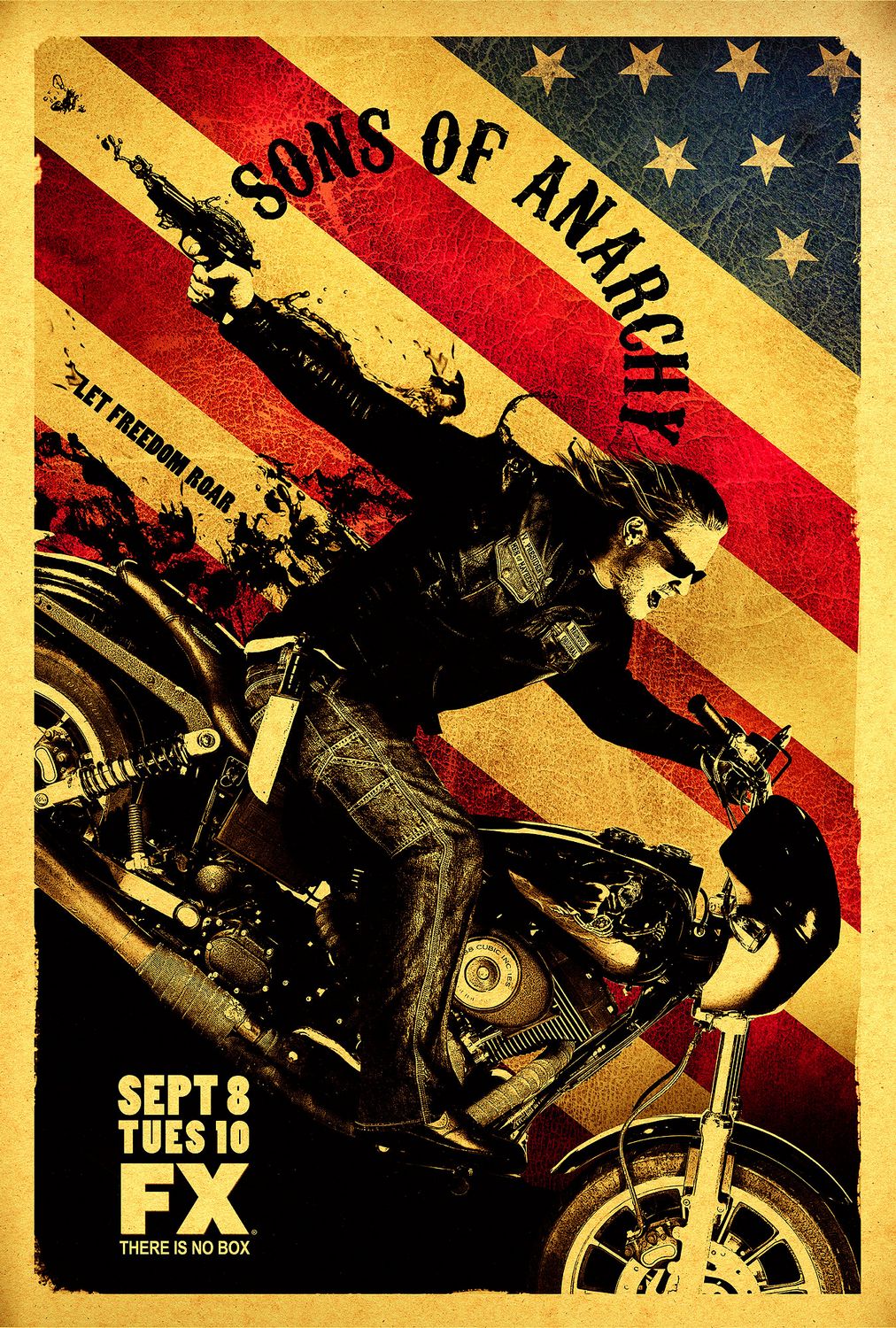
The other day, I finished watching the second season of Sons of Anarchy, and I was yet again reminded of something, which I have often thought during the last decade (and in all honesty, other minds have presented the same idea or similar ones): the cinematic equivalent to a novel is not a feature-length film, but a TV-series. The aforementioned Sons of Anarchy is a clear example of this, as is the absolutely superb series The Wire. But how? And what do I mean when I write this? Perhaps even more importantly, what does this imply for the visual medium of moving pictures?

Relax. I will explain myself.

Let us first remember the distinction between series and serial (which I have discussed earlier) and remember the fact (as also mentioned) that the TV-series format has slowly moved from a more series structured thinking to a more serial structured one. As in most cases, there is not a sharp dividing line; there is room for series with some serial elements, to be sure. However, that is not to say that clearly distinguished specimens of both categories cannot be found without any problems. For all the shades of grey, there are still black and white on the spectrum too, and the distinctions are therefore useful both in b/w terms and on a shaded scale (where the shades can still be judged in the present ratio of either category in any given case).

Given that the format has moved in this direction, it is perhaps not strange that full-blown TV-"serials" (outside of the already existing mini-series format) have proven themselves successful. But how does this relate to my claim? A novel tends to use a different pacing than a feature film. It is (usually) divided into an unset number of chapters, a feature which shapes the narrative, both in practical terms of how readers tend to interact with the text (chapter breaks often being preferred points of pauses in the reading for many readers) and in terms of dramaturgy. By the latter, I mean that chapters as a general rule are structural devices on the writer's part to create narrative units of drama that in some sense almost hologrammatically* mirror the whole. At least on a general level. Chapters often have an internal build-up, not rarely ending with a cliffhanger of sorts, which drives the reading ever onwards.

Now, feature films clearly do not lack dramaturgy and they are often, dramaturgically speaking, divided into acts (which at least on some level can be compared to chapters; this being something of a simplification of a much more complex relation, of course). Nevertheless, feature films are relatively short and definitely meant for single sitting consumption. Novels can be, but certainly need not (and in more cases than not pushes the possibility for such consumption for most readers).

In a TV-series (or -"serial" if you will), each episode serves as a dramaturgically structured unit in a larger dramaturgical structure. That is to say, each episodes functions like a chapter in a novel. Now, a feature film cannot go on hours and hours and hours on end. And yes, I am aware that some films do, but they really raise the question as to how viewable they actually are, and if, in fact, they actually resort to a somewhat episodic structure anyway, and in some sense then mimic novel/TV-"serial" structure. Still, as a general rule films over the three-hour mark are fairly rare on the whole, and many if not most tend to find them rather bothersome to watch for obvious reasons. TV-"serials" on the other hand can easily go on for hours and hours and hours and... simply because they, unlike feature films, do not go on on end. They come with ready-made pauses, where we can catch our breaths and stop for a bit to digest what has been going on. As with a novel, we can read/view one chapter/episode at a time, or as many as we happen to have time for at any given time.

Even more importantly, this less temporally compact structure allows for slower pacing, additional subplots and greater complexities on the whole. I have discussed adaptation in here before, and this certainly has bearing on it. The medium of film has always enjoyed adapting literature, but it is worthwhile noting that slimmer novels, novellas or even short fiction often make for better films. Or at least better adaptations. Simply because the ratio between story content/plot and narrative length is more even and requires less chopping off, cutting or slimming down. Naturally the line is neither singular nor sharp, at least not in terms of page count vs. playing time. After all, a thick tome spending most of its pages on visual descriptions which a camera can capture with a single image stands a much better chance of remaining intact and on time than an equally thick tome where the bulk of the pages is spent to delineate and develop a heavily complex intrigue.

Differently put, TV-"serials" not only have more time in which to tell the story, more space in which to include more story content, but also the opportunity to pace the storytelling differently, to allow for more characters and character voices to be heard, to be (in some sense at least) in focus. There is time and room for a narrative to breathe, to develop over time, and to consequently (at least potentially) hit you even harder with its moments of emotional impact.

There is no doubt in my mind that Alan Moore and Dave Gibbons' Watchmen would have made a much better TV-"serial" than a feature film. I have my reservations towards certain things in the film adaptation (some of which I may well discuss in here at some point), but my main complaint is still that even the good bits did not get time enough to breathe, were not allowed to develop and expand, but rather ended up feeling rushed (and consequently less than satisfactory). Consider the time Rorschach spends with the shrink and the slow revelation that one issue (or chapter, if you will) builds up towards, its heavy impact, and compare to the swift rush job of the film. In a TV-"serial" that would easily have been an episode in its own right. And a mighty fine one at that, if we would have had Jackie Earl Haley still doing the role.

As I write this, I have not yet had a chance to watch the TV-"serial" adaptation of George R. R. Martin's A Game of Thrones (I have watched and enjoyed the 15 minutes preview available on the HBO website), but it certainly looks promising. And it bodes well, if we are seeing the beginning of a trend that will see more adaptations from novels into moving pictures that are not feature films but TV-"serials".


* Holograms are among other things known for the fact that each piece contains the whole.

Monday, 13 September 2010

On Adaptation

In March, I wrote about what constitutes a medium. At the time, I fully intended to follow up (quite shortly) with a post on adaptation, but (as so often happens) other topics of interest popped up, and the post was delayed and postponed. Until now, that is.

Later this week, I will be speaking on the topic of adaptation at the City Library here in Göteborg as an introduction to a screening of the animated film How To Train Your Dragon aimed at school teachers. As the film (as oh so many others, including the three others that are screened this autumn) is an adaptation (of Cressida Cowell's book How to Train Your Dragon), this subject will be the topic of my introduction. And needless to say, perhaps, I figured I would put some words down on the subject in here as well, while I have it fresh in my mind anyway.

In my March post, I differentiated between material and non-material mediation, and counted media like music, literature, comics and film as non-material in that they function more like languages (with a particular sort of grammar, which definitely serves to create medium specific boundaries of possibilities for these categories) while nevertheless depending on other, material media to express themselves. In short, the argument was, and is, that it is often possible to mediate non-material media through more than one material medium (e.g. the medium of film can be expressed or accessed via celluloid film, video tape, digital video, etc; the medium of music can be expressed or accessed via vinyl discs, cassette tapes, CDs, etc). This is, of course, not to suggest that the move from one material medium to another cannot affect the content at any given time, or even that it cannot affect a non-material medium itself. Clearly developments of new material media have had huge impacts on the medium of film, but these impacts and effects differ from whatever happens when content moves between non-material media.

For the sake of clarity, I suggested that we apply the term re-mediation (which I am sure we will talk more about at some point in the future) to the transfer of content or material between material media, and that we use the term adaptation to address the transfer or translation between non-material media.

In a much earlier post from last year (while discussing the fact that comics are a medium and not a genre), I briefly brought up adaptation theorist Brian McFarlane, and it would seem appropriate to return to him here, albeit a bit more in-depth than last time. McFarlane makes a useful distinction between what he calls transfer and adaptation proper. Transfer refers to all elements in a narrative that are medium non-specific. In simple narratological terms (something which we will definitely be returning to in the future), this would be elements of story. Here we could place things like character, plot, setting, other rather basic information; in other words, the raw components of any narrative. For instance, there is nothing about the character of a blue-eyed man in shorts, who is always angry, that cannot be captured equally well in film, comics or literature (which is of course not to say that such perfect transfer always happens – and we will return to that shortly). However, as soon as these elements get told and consequently embedded in any given narrative, there will arise new elements that are medium specific. These more often than not have to with how a story is told; not just the structural organisation of it but, for instance, the difference between how a film can show the audience an entire landscape in a single shot while a novel requires extended narration with specific focus given to details at any given time (or, vice versa: how a novel through verbal narration can bring story time to a complete halt and discuss a single detail in the tapestry in-depth while a film will more or less have to resort to freeze frames and metafictional devices to emulate the same, or perhaps more aptly a similar, effect).

The narrative elements that are medium specific cannot be transferred in McFarlane's terminology; they require to be somehow translated from one language to another. This act of translation is what he means by adaptation proper.

Now, it is not unimportant in this context to note that adaptation theory and theorists have moved away from questions of fidelity (questions that admittedly are still ever of interest, e.g., whenever someone watches the film version of a beloved book). The argument here is that any film (or any type of adaptation, really) has more than one intertext. That is, like any other text, an adaptation is tied to a number of cultural texts and stories, with which it interacts on a variety of levels. This is an interesting and useful argument (no doubt about it), especially since it allows us to look more deeply into processes of multiple adaptations of the same text (i.e. how such an adaptation often ends up not only referencing the source text but also commenting the preceding sequence of adaptations) or how an adaptation often ends up referencing its own contextual (historical and cultural) time frame while relating to the source text. In short, I find that this idea definitely has its merits.

But— (there is always a but is there not?) the argument also has a weak spot, in my humble opinion. The fact is that while an adaptation has several intertexts (just as any other text), it is equally true that one of these intertexts has been put in the spotlight and given an added focus. It is a truism that there is no necessary equality between intertexts in an text, but in an adaptation there is a given notion that the source text has a privileged position. If it did not, if the source text was in fact merely one of many intertexts, why would we single it out and call the adaptation an adaptation in the first place?

This is where McFarlane's distinction becomes of the essence. After all, it is an undeniable fact that there are (more often than not) changes and differences between a source text and an adaptation. While questions of fidelity in themselves are not necessarily of (at the very least) academic interest, I would argue that the reasons for why things change are of interest both for academics and the general public. Using McFarlane's distinction we can consider which of the differences between any given source text and its adaptation(s) have been susceptible to transfer and which have required adaptation proper. With this knowledge in hand, we can then consider matters of translation inherent in adaptation proper – have these acts of translation been successful, artistic, inventive, clumsy, brilliant, missed the mark, hit the spot, etc.? At the same time, we can note differences in material that could have been transferred (because let us face it, far from all the differences in adaptations stem from adaptation proper) and consider what has caused these changes.

For instance, film is a notoriously expensive artistic medium (most likely the most expensive one we have around – thus far at least). Therefore financial factors will at least affect any adaptation into film. Then we have the question of cultural context. If a source text is produced in one culture and adapted into another, this too will mark the adaptation and quite likely be responsible for at least some of the differences. The passage of time (as in the adaptation of a historical source text) will also be a possible, and quite likely, factor to consider. Then we have issues of format (which includes length) and intended audience. The list goes on, of course, but I would like to add artistic ego as a last but not least category.

Needless to say, artistic endeavours do entail a fair amount of artistic ego, but in adaptations this is a factor which is a very double-edged sword. It can be the difference between an adapter wanting to use his or her creative energies to transfer as much as can possibly be transferred from the source text and properly adapt in as faithful a manner possible that which cannot be transferred and an adapter wanting to "fix" things in the source text, to be more artistic than the original artist or put his or her fingerprints all over the place. Do not get me wrong, there are great adapters out there, many of whom have made their marks on the finished product while remaining very true to their source text; but mostly I think the ones who manage that are those who aim to do a good job. Few if any people (in whatever medium) have ever made a mark by aiming to make a mark. But in all honesty, this point seems to be heading into a completely different area, which we may well return to on a different occasion.

To wrap things up today, I would just like to say that there are many valid reasons for changes in an adaptation to occur. Some changes are necessitated by the shift between media; as McFarlane points out, some medium specific elements require to be translated. Other changes come about from other types of necessities (e.g. getting an 800 pages novel into a 2–3 hours film will, most likely, require subplots being cut, some supporting or minor characters being cut or in some cases amalgamated, etc., in order to get a watchable film), and some will come out of no necessity at all. Surely it is not unreasonable to discuss and delineate such categories of change? If nothing else than to determine which factors alters (if only ever so subtly) the contents of any given story in an adaptation.

Monday, 29 March 2010

What Is a Medium? On Material and Non-Material Mediation

A recent discussion I had with my friend Lazy made me think about what constitutes a medium. Since I have previously both discussed comics as a medium rather than a genre ("Comics – A Medium Not a Genre") and different types of genres ("Some Thoughts on Genre"), it actually struck me as somewhat odd that I have not really discussed the concept of medium at all. What is a medium? How do we define it? Needless to say, this is the time and place to make amends for this oversight.

It could be argued that a medium first and foremost is a material condition or means through which information and ideas can be mediated. For instance, the print medium clearly differs from television in terms of the material conditions and means used for mediation of any type of content. However, it would be equally true to say that books differ from magazines or, perhaps to an even larger degree, that celluloid film differs from video tape, both of which differ from digital video. In essence, the latter leaves us with the apparent truth that films reels, VHS tapes and DVDs are clearly different media. Yet all of these media (while obviously influencing it through their respective limitations and possibilities) are all used to mediate the medium of film.

Are you confused yet?

Think of it like this: apart from being a material means to mediate something, any form of mediation also requires a sense of language. In fact, I would argue that language is, perhaps, the most potent medium which human beings have achieved. As such, language itself can be subdivided into various specific languages (e.g. English and Swedish), all of which strongly affect the mediation and may be labelled sub-media for the purposes of our discussion (cf. the notion of sub-genres). Transfer of any (kind of) message or information from one language to another requires translation, just as transfer between different media requires adaptation or re-mediation.

The distinction between adaptation and re-mediation, to my mind, depends on which definition or type of medium we are talking about. I would argue that re-mediation more strongly relates to transfer of information or content from one material means of mediation to another (e.g. the transfer of a film from VHS tape to a DVD), whereas adaptation relates to the transfer or translation from one non-material medium/language to another. Allow me to explain further.

If we return to the visual medium of film (in a general sense, i.e. not just material reels of celluloid film), this medium arguably functions more like a language than a material medium in terms of mediation. It is, above all, non-material just as languages are (while simultaneously, of course, being dependent on material mediation as well), but furthermore, it relies on a kind of audiovisual grammar that, while susceptible of being affected by "proper" language differences (as well as cultural ones), nevertheless goes beyond them in some manner.

Needless to say, perhaps, the media of music, comics and literature (to mention three examples) all rely on similar notions of medium specific grammar governing their forms of mediation. While they (like film) are all inevitably dependent on material means of mediation as well, these respective sets of grammatical rules nevertheless operate across those material media boundaries. It is quite obvious that not every non-material medium can be mediated through all other material media, but the fact that most, if not all, non-material media can be mediated through more than one material medium, quite clearly shows that there are two different types of media and mediation out there: that is, non-material and material media and mediation.

Saturday, 31 October 2009

Genre Writing and Writing Genres: Storytelling and Idiosynchrasies in Different Media and Genres

I recently wrote the post "Comics – A Medium Not a Genre", and I would like to follow up on that with a discussion on format, both in terms of medium and genre. The reason behind this is that there sometimes exists a flawed assumption that any good storyteller by default can tell a story in any medium or genre, and even worse, with equal skill. As if the art of storytelling was so universal as to negate any idiosyncrasies of medium or genre. True, there are universal elements, elements that can be used in many (if not all) media or genres, but there are nevertheless differences that cannot be overlooked.

A great poet need not make a good novelist, nor vice versa. By the same token, a great science fiction writer need not make a good fantasy writer. Nor does a writer in the medium of literature necessarily play well in the medium of film, or a film script writer well in the medium of comics.

Don't get me wrong. I'm not saying that one thing excludes the other (there are plenty of writers who have mastered writing within several genres and within several media). All I'm suggesting is that it is by no means a given.

Even if we look at the most ordinary type of narrative prose fiction and compare some writers' efforts within the same type of content genre (I will be talking more about genre in an upcoming post), but in terms of novels and short stories, there are clearly some writers who are either better at the succinct format or at the longer one. The former might seem to drag his/her material out or even get lost in the effort when writing in the longer format, whereas the latter might seem cut short in the briefer format. In fact, it might not even be so clear cut a deal, not a question of good or bad as much as "not quite as good." The point, however, nevertheless stands.

And what this points to is that a writer must know and master the format. Whether the format is a genre or a medium (or even more likely an intersection of genres in a medium; say a science fiction thriller novel, citing a cross-breed of two content genres (SF and thriller), one format genre (the novel), told in the medium of literature), it is a question of knowing how that genre and/or medium functions.

In my post on comics as a medium (referred to in the opening line), I brought up the example of Angel After the Fall in order to show a difference between the media of comics and film. This difference was shown by my pointing to a failure on Brian Lynch's part to understand it in his writing a comics script that (at least partly) reads like a film script. The end result in this particular case, as stated, is not bad (not at all, I hasten to add), but there is no escaping the fact that the inclusion of Lynch's script reveals an intended effect that has not only failed to come across in the finished product; it never had a chance of coming across in that way in the first place, simply because comics aren't film (for details on the argument, see that earlier post).

From my own point of view, understanding a medium or a genre is part of the fun of tackling a particular medium or genre. Writing the script for a film or a comic should not be handled the same as writing a novel, nor even writing a comic script as you would write a film script. There are differences (sometimes subtle, sometimes not so subtle), but the writer needs to understand these. He or she needs to play to the strengths of the medium at hand, and be aware of any potential weaknesses.

For instance, adapting Joyce's famous stream of consciousness ending of Ulysses to film with an ongoing (near mad) voice-over narration would, most likely, be catastrophic in terms of film-making and most likely quite boring (and yes, there are, of course, those who would argue that Joyce's own version isn't exactly a whole lot of fun either, but bear with me). Translating the sequence to a visual stream of consciousness perspective, however, might better suit Joyce's idea in itself, not to mention work much better in the medium of film. And, while a director is clearly the artistic captain of the film-making ship, it behoves the script writer nevertheless to write for the medium at hand. Because why should he or she write a lengthy, wordy, voice-over adaptation of Joyce's monologue if it is to be thrown out from the get go? Why not think that little bit extra and write a set of visual cues for the director to stage and operate? After all, a script writer for a film is not writing a novel (something that should be even more abundantly clear in a case of adaptation as just hypothetically described), but a script for a film. Shouldn't that script in itself be a blueprint to a successful finished product? Shouldn't it be all about visualising just that?

Maybe it's just me, but it seems strange to happily attempt to write for a medium or a genre without contemplating what it is, how it works, and how you could make it work for your story.