Showing posts with label film. Show all posts

Tuesday, 28 August 2012

Secret Identities, Origin Stories and Never-ending Continuities: On Superhero Films and Some of their Problems

Having seen The Avengers, The Amazing Spider-Man and The Dark Knight Rises this year (liking them all to different degrees), I have been struck by a few things that seem to continuously manifest themselves as the superhero genre has migrated from the four-coloured pages of comicbooks to the silver screen, and problematically so, I would argue.

This post will focus on three things: secret identities, origin stories and never-ending continuities. All of these (mostly) seem to become problematic in the genre's transition from one medium to another.

Let's start off with secret identities. This conceit is central to the superhero genre. It is not that there aren't exceptions (the Fantastic Four leaps to mind, for instance), but most superheroes do have them. And they have them for a reason.

While fans love debating which identity is any given character's "true" identity (e.g. is Superman really Superman sometimes pretending to be Clark Kent, or is he Clark Kent sometimes pretending to be Superman?), the idea of the dual identity is deeply rooted in another idea: that doing what heroes usually do tends to go together with making enemies of the more violent kind, who would just love to know about all the hero's relatives and friends in order to hit him/her where it hurts.

Now, recent superhero films tend to pay a faux tribute to this concept. Sure, Spider-Man is still Peter Parker when Andrew Garfield plays him, but the secretly bit is kind of whittled away. After a while, Garfield is leaping about without mask more than with it, it seemed. And before long, a bundle of other characters know fully well that Peter Parker is Spider-Man. Don't get me wrong: I like Marc Webb's reboot. In some places I think it is superior to the Raimi "trilogy" (e.g. hello mechanical web-shooters!), in others less so. However, among the things I find really off-putting is this failure to grasp the importance of keeping the secret secret.

While The Avengers also fails in this – Tony Stark is publicly Iron Man since the ending of his first film; Captain America is running around without mask as much as with mask (which I'd say is fairly public); Hawkeye has done away with mask altogether (I excuse Black Widow, since she hasn't been masked in the comics since the 60s, I believe); and Thor has done away with a civilian identity altogether – with the exception of the overly maskless Cap (who had a good hood and all), the context makes it work better; consequently, I am more forgiving here.

Secondly, we have origin stories. These stories are crucial to superheroes in that they are the central to the character, a sort of frame for what he/she is and why. However, as such, they are backdrops defining the characters, but not necessarily stories that needs to be told as the main story – front and centre.

I understand that origin stories are tempting when a superhero is adapted to the big screen. After all, it is a central story and possibly the story with which a larger audience is somewhat familiar (if familiar at all). Still, I find the notion that every (yes, I am exaggerating) superhero film has to be an origin story, unless it has a number behind the title (in a manner of speaking), highly annoying. Add to this the recent trend of rebooting every franchise within three films or so (if that), and you not only have a continual stream of origin stories reaching the big screen, but a continual stream of versions of the same origin stories over and over again. Originitis is killing off potentially good stories by repeating till fade.

If you want to see a good example of rebooting, watch Leterrier's The Incredible Hulk. It is clearly a reboot, with a different version of the origin than that presented in the earlier Ang Lee film. The story of Leterrier's film, however, is not that origin story. That story is neatly presented to the viewer in the credits sequence at the opening of the film, basically doing what I mentioned above: it provides a frame for the character. The story that follows is another story, and one I really enjoyed at that.

Part of the problem with originitis is that it blocks the creative process. Not only does many if not most heroes carry with them any number of other classic stories or story arcs that could potentially be adapted into film or drawn upon, there is also a great narrative strength in the fact that these characters as a general rule are constructed to carry continuous stories in unspecified numbers. That is to say, new stories ought easily be folded in and presented, on the big screen just as easily as in a new issue of the comicbook.

Which nicely leads us to the final thing on my agenda, i.e. never-ending continuities. Superheroes are the type of characters who are mythic in nature. In revisiting Raimi's conclusion to his Spider-Man trilogy earlier this year, my friend Zaki Hasan wrote: "I've often heard superhero stories likened to modern mythology as a way, perhaps, to make the former sound more important than they are, but the big difference is that, unlike Robin Hood or King Arthur, there's no Sherwood burial or flight to Avalon for Batman or Superman or their ilk." While this would seem to contradict my preceding statement, I would rather suggest that Zaki here fails to distinguish (quite usefully, I would argue) between myth and legend. Myth carries with it the cloth of mythology, which more than anything is a vast canvas of interrelated character about whom stories upon stories upon stories are told. Compared to the legends of King Arthur or Robin Hood, who more clearly have dramatic arcs, the gods of the Norse men or the Greek were religious stories of continuous example. Basically, the idea of character clearly supersedes that of plot (which is not to say that the latter is altogether insignificant).

Superhero stories belong in this category too. There is not a finite number of Spider-Man tales to be told, but a multitude of possibilities. What is important is the character, and whatever stories he can carry. Any of these stories needs to have a beginning, a middle and an ending (like all stories do), but they need not be the beginning (originitis) or even more importantly the ending of the character.

With this in mind, the current trilogyitis (going hand in hand with the originitis, it seems) only forefronts the issue. Instead of creating an interesting version and allowing others to play with the concept in the same playground – building a cinematic continuity that allows for (if not necessitates) interesting links to be made and stories to intermingle and build upon each other – it appears as if more or less every director wants to mark his/her territory so badly that they pee all over the place.

And it should not be necessary. Marvel Studios has successfully shown that cinematic continuity is not only possible, but a hugely successful concept (I willingly admit that part of me wept a little when I read an interview in which Shane Black, director of Iron Man 3, talked about his film as the concluding part of the trilogy). Whedon's Avengers not only builds upon the preceding films and serves as their culmination; it suggests further stories. Quite possibly an endless supply of stories.

The idea here is not that a (nigh) endless sequence of stories need be told, but rather that any story should suggest itself as part of such a sequence even if the sequence itself never exists.

To give an example, and return to the distinction between myths and legends, or fairy tales, I would like to quickly bring up Tim Burton's two Batman films. Now, I will confess to being a huge Burton fan, and I do like his Batman films, but there are some elements that has never sat right with me. And I pegged what the problem was fairly early on in life: Burton's genre par excellence is the fairy tale. Almost any Burton film corresponds to this literary genre. Now, the fairy tale, much like the legend, is very much plot driven. In fact, the former is probably a bit more so than the latter, since the plots of legends seem more obviously centred on central characters (e.g. King Arthur or Robin Hood), whereas the characters of fairy tale to a much greater degree are more easily reducible to types (e.g. Snow White or Cinderella). In a fairy tale, the beginning, middle and ending are the beginning, the middle and the ending: in a nutshell, the be-all of plot and story.

So where does this leave us with regards to Burton's two Batman films (after all, there are clearly two, which would seem to contradict my point)? Well, fairy tales solve their plot permanently, and quite often violently. Not that superhero stories do not use violence, but mostly death is kept out of the equation (obviously with exceptions). Or if death occurs, the reader usually craves a body (mostly withheld) in order to believe this "death" is in any way permanent. What I am getting at here is the idea of rogues' galleries, of arch enemies, of cycles of enmity and battle. Burton notably kills off both the Joker and the Penguin, removing them from that continuity after their first appearance (in this context, it is worth noting that Nolan did an even greater injustice to Two-Face in The Dark Knight, not even allowing the character a full appearance before removing him). These are two classic arch enemies in Batman's rogues' gallery and to Burton they simply appear expendable at the altar of plot and story, as if a single story is enough not only to characterise these characters or their relationship to the Batman, but also to tell all there is to tell about the characters.

I am reminded of a brilliant little Batman story I read as a teenager back in the late 80s (notably before switching to reading American comics in original). The title, which sadly escapes me in detail, was something with "circles" or "symbols", or similar. The point of it, which has stayed with me, was Batman meeting a gypsy fortune-teller, while searching for the Joker. In her reading of Batman (whether by tarot or crystal ball, I forget), she sees the cyclical nature of the relationship between Batman and the Joker (something which both Frank Miller and Alan Moore respectively touch upon in The Dark Knight Returns and The Killing Joke also). The story was not long, as I recall. I'm not sure if it would have been a full American issue even, but it really nicely pinpointed this phenomenon, which somehow strikes me as a core concept in the genre: the villain always (okay, another exaggeration, but bear with me) returns. And the hero avoids killing the villain, because killing is not what heroes do.

To wrap up, I sincerely hope the trend is turning. I hope that secret identities will become secrets to be kept yet again. I hope that we will get more than just origin stories on repeat. And I hope ever so much that we will get more middles. Middles all the way up, to borrow from an old saying about turtles.

Monday, 12 December 2011

On Adaptation Revisited: Fidelity, Quality and Translation

In the past week, I attended a doctoral colleague's work-in-progress seminar, which touches on one of my interests: adaptation. Now, old readers know that I have written on adaptation in here before (and also on the related question of what constitutes a medium), but the seminar made me think about a few things yet again and it seemed appropriate to revisit the subject.

The seminar once more revealed the seemingly great bogeyman of adaptation studies and theories: the issue of fidelity. For some reason, this issue is deemed very problematic, and has people twisting themselves every which way to avoid it. I cannot help but ask why? In truth, to my mind, the issue is much less problematic than most of these critics and theoreticians seem to think, and I will explain why.

Regardless of what medium one adapts from and to, there is a need to distinguish the process of adaptation from the resulting adaptation. The former is arguably an act of translation, a word which etymologically comes from the Latin translatus, i.e. literally "carried across" (see Merriam-Webster). However, as has been noted many times, the act of translation (whether between languages or media) is never a simple process of transfer, but one that always, without exception, involves change on some level. The etymology of the word "adaptation" ("from Latin adaptare, from ad- + aptare to fit, from aptus apt, fit") is arguably a good indication of this aspect, as the idea that necessary changes occur in the process can be seen as the result of the act of fitting something into a different language or medium, and act of metaphorical tailoring attached to the process of the transfer of content. The resulting adaptation, however, is never just a result of that process; it is also a narrative object in its own right.

So what do I mean with this distinction and why do I stress it? Well, the process of translating anything — whether it is translating a text in Swedish to English, or a narrative in literature to film — implies a given source material that needs to be carried across a void of difference, from one language or medium to another; ultimately being fitted into its new location. As such, fidelity can arguably be seen as the mark of a successful process: Was the material carried across adequately; and was it made to fit its new language or medium?

However, fidelity in itself will never tell us if the resulting narrative object is any good. Arguably, one could conceivably transfer and adapt properly (to use Brian McFarlane's distinctions) more or less everything from the source text into the new object (if you will), but without making that object a good one. Sticking to the classic example of adaptation from literature to film, this would basically mean turning a good book into a faithfully adapted but ultimately poor film.

Please note that I am not saying that faithful adaptation is impossible. I am merely pointing out the rather obvious, yet sometimes quite forgotten truth, that fidelity is not a mark of qualitative narrative. In fact, I think that it is this very forgetfulness that haunts adaptation studies and causes the rather unnatural twists and turns in the discourse in trying to shun notions of fidelity and a source text. It is not that the narrative object to come out of the process is not tied into a web of intertext all its own, but clearly the fact that we talk about it as an adaptation of another text means that one of its intertexts is singled out and heavily emphasised. To pretend otherwise seems to be missing something very fundamental about the process.

Similarly, to merely point out failure to be faithful is equally missing the point. The core question here is rather why than what. This is where formalist theories like McFarlane's is so useful. It allows us to delineate what can be transferred (rather simplistically) and what requires adaptation proper (i.e. medium specific changes). Needless to say really, the process at very least mostly involves changes that strictly speaking are not necessary (from the point of view of possibilities in the target medium) and those instances (like those of adaptation proper, I would argue) are what is truly interesting. They are what gives us insights into dimensions beyond the media specific, let us call them societal dimensions to the processes of translation and adaptation. These include ideological, economic, cultural, and even individual-related factors; because an adaptation is never only a question of transfer, or even of making a good narrative object for that matter. (The latter obviously not being unique to the process of adaptation, but a condition it shares with all artistic endeavours to various degrees.)

Art is always produced in an historical and cultural context; it involves individuals in existing ideological and economic systems. Granted that some media are less dependent upon the latter (e.g. literature in its rawest form) than others (e.g. film-making). It would be foolish to think these factors would not also affect the processes of translation and adaptation, just as it would be foolish to assume that the effect itself would be identical (in a heterogenous fashion, I will grant you) to the production of art that does not involve these processes. From an academic point of view, however, these questions would seem not only highly relevant and interesting, but also something that ought to be situated at the very core of adaptation studies.

In short, I think adaptation studies, theory and theorists need to get over both their reluctance towards fidelity and source material, and their willingness to let these concepts blur all boundaries.

Monday, 5 September 2011

Superman Goes Commando! (In a Manner of Speaking)

On Saturday, I caught up with an (as per usual) interesting blog post by Zaki Hasan from the previous day: "Why Superman Needs The Red Underoos."

The post ties in with DC's latest stunt, a total company-wide reboot of their entire line and fictional universe (let's not even get started on that one), and more specifically focuses on their redesign of Superman. The man of the hour here is Jim Lee, who is the man responsible for rethinking and revamping an old faithful design (which has already, admittedly, seen some variations over the years, while nevertheless keeping a basic design intact). Apparently, the first view of this new design can be seen in a single panel in the debut release of the rebooted Justice League #1, and the most radical changes appear to be the addition of a collar and the loss of the otherwise ever-present red-underwear-on-the-outside.

Now, as Hasan points out, the red-underwear-on-the-outside has always been a point open to derision, but I could not agree more with his assessment that "the red trunks (along with the yellow belt) [...] helped give a much-needed sense of visual balance," which the Lee version clearly lacks.

However, the loss of the red trunks is not limited to DC's reboot of the character. This week has also provided the first full frontal look of Henry Cavill in his Superman regalia. Cavill is the actor portraying the character in the upcoming Man of Steel, directed by Zack Snyder and produced by Cristopher Nolan, and currently being filmed. (The photo is from on-set, so the colour scheme is not necessarily a definite match to what the film will show, I hasten to add.)

While the fact that this version (at least) has no collar produces a less fascistic and more traditional looking hero, the lack of even a (wrongly) coloured belt seems to underline Hasan's point about visual balance. However, there is more to it than that. Even discounting Cavill's somewhat awkward pose in this picture (which honestly looks quite a lot like a man in need of a bathroom break),
if we think of the traditional skintight superhero costume as a comic book shorthand for the perfected human form, then the need for modesty — and thus the whole "underwear on the outside" thing — starts making a lot more sense. Just look at Cavill's...*ahem*...area to understand what I'm talking about.
I can but agree, yet again, with Hasan's assessment here.

Monday, 13 June 2011

Newness, that Newfangled Thing

Our topic today is newness. Or rather a certain obsession with the new and its supposed hierarchical superiority to the old. Well, at least in terms of artistic consumerism; i.e. reading books or comics, watching films, or listening to music. I would never suggest that the new in and of itself has a higher hierarchical position in, for instance, old-school academia. Although, it is worthwhile noticing the common critical (academic or otherwise) favouritism of originality, of which I've written before.

While I do not necessarily see the necessity for originality as a quality marker of storytelling, I can certainly understand the endeavour to go where no author, artist, film maker or songwriter has gone before (even though the likelihood of an actual success in that seems meagre and more illusory than real), what I want to discuss here and now is the notion held by more than a few people (and naturally fostered by the market place) that only the latest thing is good enough. This is not to say that whatever the latest thing is is original (or even claims to be), but the idea of defining newness in these fields as only the latest thing is foreign to me.

As a reader, viewer or listener, I utterly fail to see why I have to be obsessed with the latest thing.

Don't get me wrong. I'm not saying we cannot appreciate the latest thing to be published or produced for our reading, viewing or listening pleasures. But why be obsessed with it? When there are so many things in all temporal directions from us, yet to be discovered. Some of which we've surely not yet even heard.

Let me confess openly: I have not read every book or comic ever written or published, not seen every film film ever made nor heard every song ever recorded. In fact, I have not even read/seen/heard all the ones I know would like to. This is quite simply because the treasure chest of such material is nigh infinite (at least in comparison to my own time here on Earth), and everything that I've not (yet) read, seen or heard is something new... to me.

Obviously this is not a condition unique to me. I would dare say that there is no one out there who has literally read, seen or heard everything in any of the mentioned categories. Thus, we need to rethink what newness is, I would argue. We cannot allow our treasure chests of the imagination to be dominated by a simple market place insistence on the latest hype; that is to say, newness only as that newfangled thing which like a flash in the pan is here today and gone tomorrow. It is true that not all books, comics, films or music remain in the public consciousness (in fact, it is probably more true to say that few do). But even a passing fancy is something which somebody may pick up long after that moment is gone, and enjoy or not, in very much the same manner people could whenever the hype was on.

In fact, perhaps some of these things will find a better appeal when they are not over-marketed and only get to stand on their own two legs. I'm not saying that the fame will be eternal, but there may nevertheless be an appreciation of finding something new, as in previously unread, unseen or unheard (perhaps even unheard of).

Monday, 9 May 2011

Twisted Endings

In the wake of recently having watched, and been majorly disappointed by, the fifth season of Supernatural, I would like to talk about stories with a twist, or perhaps more specifically stories that end with a twist.

Now, the phenomenon is nothing new. Far from it. In all honesty, I doubt whether there is ever a time when it is not in use somewhere on the globe, in some narrative medium. However, I believe it is equally true that there are occasions when the phenomenon waxes in usage and becomes (for the lack of a better word) trendy. This could arguably be seen in the mid-nineties when the success of Bryan Singer's The Usual Suspects seemingly created a wave of films using twist endings.

One of the more successful ones to come out of that wave was M. Night Shyamalan's The Sixth Sense, which in many ways (unfortunately) led Shyamalan into making a full blown career of films ending with a twist. (In fact, having no actual twist at the end would probably be the most surprising twist a Shyamalan film could have nowadays.) What makes The Sixth Sense, like The Usual Suspects, so good is the fact that the twist at the end works. And there's the rub. In order to tell a good story with a twist ending, one needs to understand the mechanics of the phenomenon.

A twist ending just for the sake of the twist is rarely any good. At the very least, in the few cases where it is, there is very little enjoyment to be had by revisiting the tale. More importantly, a twist ending must be carefully constructed and worked into the story proper. This quite naturally interacts with the first parameter, as it quite strongly suggests that a twist ending will not save a bad story. It will just be a bad story with a twist ending, and quite possibly a bad twist ending at that.

To exemplify: I remember creative writing exercises in primary school where one had a session in which to write a story. Mostly the sessions were too short to really allow for carefully constructed narratives, and it was nigh inevitable that time would run out somewhere in the middle, paving way for twist endings involving the annihilation of the Earth by nuclear doomsday devices that had no real place in the story prior to their surprise appearances at the end. Surprising, why yes. No one could see that one coming. Simply because this had no foundation in the story told. It was the kind of surprise which breaks the suspension of disbelief and all sense of narrative logic.

In reality, of course, life does not necessarily move along narrative lines. Events happen from left and right somehow, but interestingly, whenever we try to narrate these events, we do tend to at least try to induce logical relations between things, try to establish neatly visible lines between any effect to some sort of given cause. In fiction, this becomes a central rule of the game.

I believe it was Russian author Anton Chekhov who said of short fiction writing that if you introduce a gun on the wall, it needs to be used before the end of the story. While this rule requires modification of sorts to be applicable as a general rule for fictional storytelling (whatever the medium and whichever the length), I still find it useful to illustrate the core point when it comes to functional twist endings. That is to say, the ending while aimed to be a surprise for the reader/viewer, nevertheless requires the sensation of being obvious or a given once it has jumped out of the box.

The nuclear annihilation of the world above is clear not such a thing. It is surprising simply because it is a twist that attaches itself to the story from without. The good twist ending, on the other hand, is something which the narrative subtly builds towards, albeit without revealing its hand to soon. At least ideally. The art lies in pulling that balance off in the reader/viewer's mind, which may well be an intricate high wire act: to be enough grounded without being too obvious before it is all revealed.

Clearly, detective fiction is a fertile ground for this kind of practice at its most basic level. Nobody would want to read a whodunnit if the murderer at the end was revealed to be a person never mentioned in the story. The surprise would no doubt be phenomenal, but it would pretty much be a case of giving someone a puzzle where you take pieces out of the box and replace them with pieces from another puzzle (by default making the puzzle unsolvable).

Unlike whodunnits, however, most stories with a twist do not introduce themselves as puzzles. At least not in quite the same manner. And that, in part, is the root of the surprise. As readers/viewers, we are given a carefully constructed puzzle but without being told that it is a puzzle. We are given all the pieces, but subtly presented; most likely not even as pieces.

This is why I never appreciate reviewers who talk about twist endings. As you may recall, I have talked about spoilers as a very clear example of bad reviewing. While the mention of a twist ending might not seem to be a spoiler (well, as long as the actual twist is not revealed), I would argue that it in fact is. As soon as we are told that the narrative is a puzzle to be solved, we will look at it in a different manner. Just like we read whodunnits constantly trying to figure out who the killer is, we will read/view the narrative with an eye to figure out what the twist will be, instead of being utterly surprised by it.

And a good twist will surprise us. And part of that surprise will be how on Earth we did not see it coming.

Monday, 25 April 2011

A Feature Film Is Not the Equivalent of a Novel

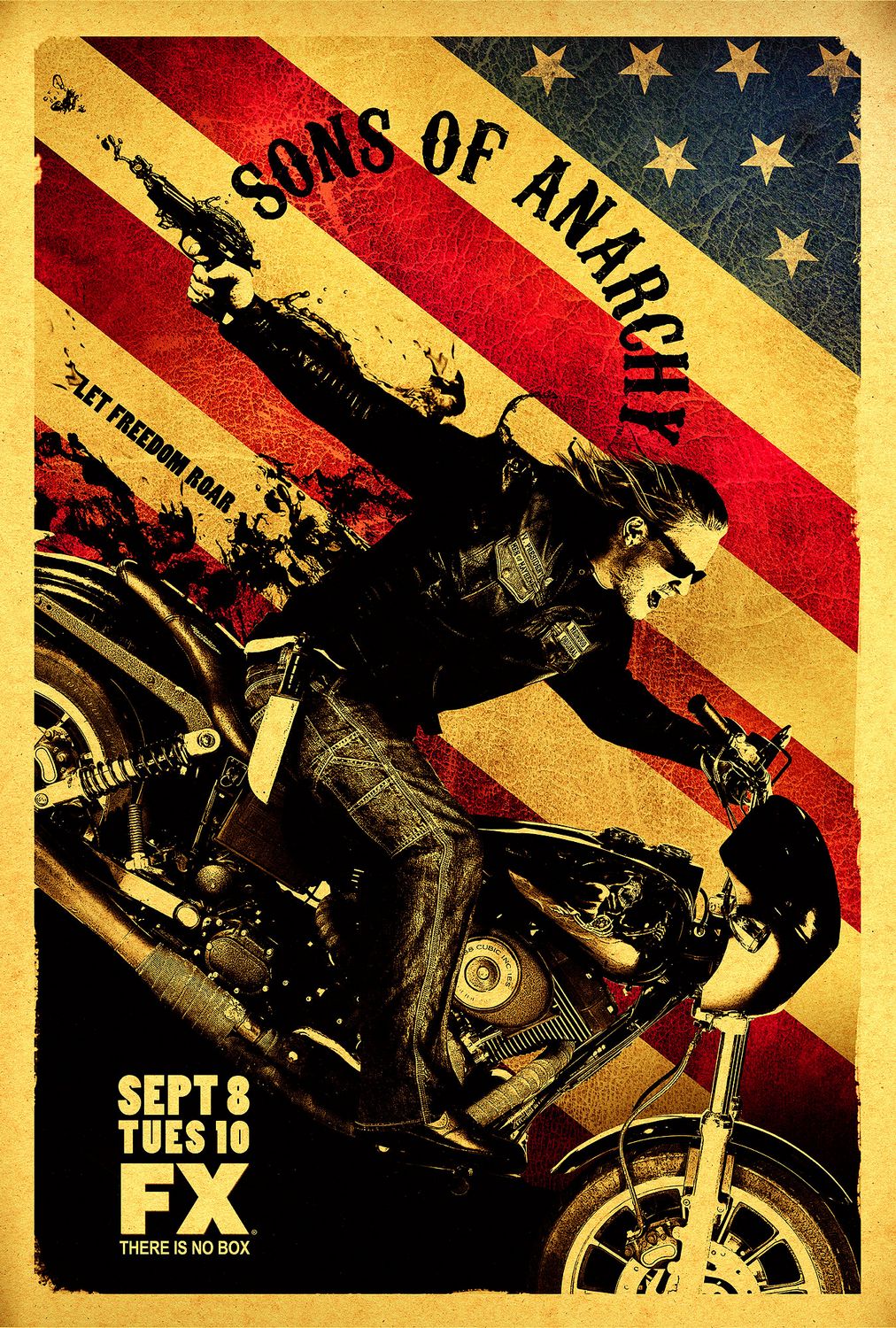
The other day, I finished watching the second season of Sons of Anarchy, and I was yet again reminded of something, which I have often thought during the last decade (and in all honesty, other minds have presented the same idea or similar ones): the cinematic equivalent to a novel is not a feature-length film, but a TV-series. The aforementioned Sons of Anarchy is a clear example of this, as is the absolutely superb series The Wire. But how? And what do I mean when I write this? Perhaps even more importantly, what does this imply for the visual medium of moving pictures?

Relax. I will explain myself.

Let us first remember the distinction between series and serial (which I have discussed earlier) and remember the fact (as also mentioned) that the TV-series format has slowly moved from a more series structured thinking to a more serial structured one. As in most cases, there is not a sharp dividing line; there is room for series with some serial elements, to be sure. However, that is not to say that clearly distinguished specimens of both categories cannot be found without any problems. For all the shades of grey, there are still black and white on the spectrum too, and the distinctions are therefore useful both in b/w terms and on a shaded scale (where the shades can still be judged in the present ratio of either category in any given case).

Given that the format has moved in this direction, it is perhaps not strange that full-blown TV-"serials" (outside of the already existing mini-series format) have proven themselves successful. But how does this relate to my claim? A novel tends to use a different pacing than a feature film. It is (usually) divided into an unset number of chapters, a feature which shapes the narrative, both in practical terms of how readers tend to interact with the text (chapter breaks often being preferred points of pauses in the reading for many readers) and in terms of dramaturgy. By the latter, I mean that chapters as a general rule are structural devices on the writer's part to create narrative units of drama that in some sense almost hologrammatically* mirror the whole. At least on a general level. Chapters often have an internal build-up, not rarely ending with a cliffhanger of sorts, which drives the reading ever onwards.

Now, feature films clearly do not lack dramaturgy and they are often, dramaturgically speaking, divided into acts (which at least on some level can be compared to chapters; this being something of a simplification of a much more complex relation, of course). Nevertheless, feature films are relatively short and definitely meant for single sitting consumption. Novels can be, but certainly need not (and in more cases than not pushes the possibility for such consumption for most readers).

In a TV-series (or -"serial" if you will), each episode serves as a dramaturgically structured unit in a larger dramaturgical structure. That is to say, each episodes functions like a chapter in a novel. Now, a feature film cannot go on hours and hours and hours on end. And yes, I am aware that some films do, but they really raise the question as to how viewable they actually are, and if, in fact, they actually resort to a somewhat episodic structure anyway, and in some sense then mimic novel/TV-"serial" structure. Still, as a general rule films over the three-hour mark are fairly rare on the whole, and many if not most tend to find them rather bothersome to watch for obvious reasons. TV-"serials" on the other hand can easily go on for hours and hours and hours and... simply because they, unlike feature films, do not go on on end. They come with ready-made pauses, where we can catch our breaths and stop for a bit to digest what has been going on. As with a novel, we can read/view one chapter/episode at a time, or as many as we happen to have time for at any given time.

Even more importantly, this less temporally compact structure allows for slower pacing, additional subplots and greater complexities on the whole. I have discussed adaptation in here before, and this certainly has bearing on it. The medium of film has always enjoyed adapting literature, but it is worthwhile noting that slimmer novels, novellas or even short fiction often make for better films. Or at least better adaptations. Simply because the ratio between story content/plot and narrative length is more even and requires less chopping off, cutting or slimming down. Naturally the line is neither singular nor sharp, at least not in terms of page count vs. playing time. After all, a thick tome spending most of its pages on visual descriptions which a camera can capture with a single image stands a much better chance of remaining intact and on time than an equally thick tome where the bulk of the pages is spent to delineate and develop a heavily complex intrigue.

Differently put, TV-"serials" not only have more time in which to tell the story, more space in which to include more story content, but also the opportunity to pace the storytelling differently, to allow for more characters and character voices to be heard, to be (in some sense at least) in focus. There is time and room for a narrative to breathe, to develop over time, and to consequently (at least potentially) hit you even harder with its moments of emotional impact.

There is no doubt in my mind that Alan Moore and Dave Gibbons' Watchmen would have made a much better TV-"serial" than a feature film. I have my reservations towards certain things in the film adaptation (some of which I may well discuss in here at some point), but my main complaint is still that even the good bits did not get time enough to breathe, were not allowed to develop and expand, but rather ended up feeling rushed (and consequently less than satisfactory). Consider the time Rorschach spends with the shrink and the slow revelation that one issue (or chapter, if you will) builds up towards, its heavy impact, and compare to the swift rush job of the film. In a TV-"serial" that would easily have been an episode in its own right. And a mighty fine one at that, if we would have had Jackie Earl Haley still doing the role.

As I write this, I have not yet had a chance to watch the TV-"serial" adaptation of George R. R. Martin's A Game of Thrones (I have watched and enjoyed the 15 minutes preview available on the HBO website), but it certainly looks promising. And it bodes well, if we are seeing the beginning of a trend that will see more adaptations from novels into moving pictures that are not feature films but TV-"serials".


* Holograms are among other things known for the fact that each piece contains the whole.

Monday, 17 January 2011

Let Writers Be Writers: Musicians Musicians and Film Makers Film Makers Too

This past summer, I came across across an article by Mike Masnick over at Techdirt that I fully intended to blog about. Other subjects have kept coming in-between, and thus that post was never written. In all honesty, this post is not it either, but (for reasons I will return to) some of the basic gist of what I opposed in the article has just recently been given new immediacy here in Sweden.

Masnick's article dealt with copyright issues and was a response to some things written by composer Jason Robert Brown on his blog. Among other things, Masnick quotes Brown: "The blueprints for your house should be free. Movies should be free. The DSM-IV should be free, regardless of the expense required to create these things." He then responds by writing:
This is really frustrating because people accuse me of making this kind of statement all the time. It's not should, it's will. 'Should' is a moral argument. 'Will' is a predictive economic explanation. People aren't saying the information 'should' be anything. They're saying it will be -- or, more likely -- already is. Again, the question is what do you do about it? Falsely claiming people are giving it moral value by saying 'should' twists an economic/business model debate into a moral one.
Perhaps needless to say, I have a couple of problems with Masnick's argument.

First of all, it allows for no ethical dimension in an economic/business discourse. Or rather, his argument never considers whether the fact that something is a certain way means that it should, or ought to, be that way (i.e. is it ethically sound). By way of an admittedly very rough but also very clear analogy, slavery was an economic reality and it was hardly financial reasons that drove that foul practice out of existent in most culture; it was ethical reasons. In fact, given slave-like conditions in manufacturing in certain Asian and African countries, one can only assume that capitalism per se has absolutely no problem whatsoever with the concept of slavery.

Secondly, I find that Masnick's analysis lacks a certain depth. In not better analysing what will be (or perhaps already is), Masnick fails to consider possible implications and consequences of this predictive economic explanation. Now, the quote above is, as stated, a direct response to the following Jason Robert Brown quote: "The blueprints for your house should be free. Movies should be free. The DSM-IV should be free, regardless of the expense required to create these things." If we focus on the second sentence (i.e. the one referencing the medium of the film) and apply Masnick's logic that films will be free (if they are not already), this raises an important issue: Who will make films for free?

Oh, sure enough, there would probably be some ventures made, but clearly the most expensive artistic/entertainment medium we have created would suffer if there would be no money to be made, because who would want to invest? Masnick's analysis may be correct on one level (i.e. that the situation with, currently illegal, downloading may well suggest the predictive economic explanation he sees), but fails to go deep enough to see that this condition might actually lead to there being no film production at all. At which point at least I feel it appropriate to ask: Is that what we want?

So what has given this the new immediacy mentioned in the opening of this post? Well, in the last week or two, there has been something of a public dispute between Swedish author Björn Ranelid and the permanent secretary of the Swedish Academy, historian Peter Englund. The whole (somewhat ludicrous) affair started when Ranelid, currently a participant in the latest edition of the Swedish version of the TV program Let's Dance, threw out the challenge that the members of the Swedish Academy should leave their ivory tower and participate in this program (or at the very least others like it, presumably).

So what does this have to do with Masnick's article? Well, Masnick and his ilk continuously propose that musicians, film makers, even authors, adapt to the current market and develop new business models. In short, this means a view where for example an author should write his books for free and gain payment some other way, be it on lecture/reading tours or participation in TV programs, etc. Personally, I have two major problems with this idea.

Firstly, I doubt many other workers would accept it if you went up to them and said, "So, hey, we're not going to pay you for your work from now on, but we want you to continue doing it. We understand that you want to be paid, but you just have to do something else on the side to make money." I dare you to try it with a construction worker or a doctor.

Secondly (and sticking with the example of writers), the qualities of writers do not require them to be loquacious, quick-thinking or witty. Heck, they are in no way required to be any type of public performers. What is required by any given writer is a good imagination, a way with words and an understanding of the craft of writing.

Do not get me wrong. I am by no means saying that a writer cannot be a loquacious, quick-thinking and witty public performer who thrives in front of stadium-size audiences. I am merely pointing out that the two are unrelated, and that, perhaps more importantly, there is something seriously wrong if we promote writers not on the basis of their writing, but on how they perform in (at the very least somewhat) unrelated fields. Personally, I am not comfortable with this. I want to read good books, not books by people who happen to be good on stage or in TV sofas, etc (although I do not, as ought to be clear by now, mind reading good books by the latter).

So, for crying out loud, let writers be writers, musicians musicians and film makers film makers too!

Monday, 13 September 2010

On Adaptation

In March, I wrote about what constitutes a medium. At the time, I fully intended to follow up (quite shortly) with a post on adaptation, but (as so often happens) other topics of interest popped up, and the post was delayed and postponed. Until now, that is.

Later this week, I will be speaking on the topic of adaptation at the City Library here in Göteborg as an introduction to a screening of the animated film How To Train Your Dragon aimed at school teachers. As the film (as oh so many others, including the three others that are screened this autumn) is an adaptation (of Cressida Cowell's book How to Train Your Dragon), this subject will be the topic of my introduction. And needless to say, perhaps, I figured I would put some words down on the subject in here as well, while I have it fresh in my mind anyway.

In my March post, I differentiated between material and non-material mediation, and counted media like music, literature, comics and film as non-material in that they function more like languages (with a particular sort of grammar, which definitely serves to create medium specific boundaries of possibilities for these categories) while nevertheless depending on other, material media to express themselves. In short, the argument was, and is, that it is often possible to mediate non-material media through more than one material medium (e.g. the medium of film can be expressed or accessed via celluloid film, video tape, digital video, etc; the medium of music can be expressed or accessed via vinyl discs, cassette tapes, CDs, etc). This is, of course, not to suggest that the move from one material medium to another cannot affect the content at any given time, or even that it cannot affect a non-material medium itself. Clearly developments of new material media have had huge impacts on the medium of film, but these impacts and effects differ from whatever happens when content moves between non-material media.

For the sake of clarity, I suggested that we apply the term re-mediation (which I am sure we will talk more about at some point in the future) to the transfer of content or material between material media, and that we use the term adaptation to address the transfer or translation between non-material media.

In a much earlier post from last year (while discussing the fact that comics are a medium and not a genre), I briefly brought up adaptation theorist Brian McFarlane, and it would seem appropriate to return to him here, albeit a bit more in-depth than last time. McFarlane makes a useful distinction between what he calls transfer and adaptation proper. Transfer refers to all elements in a narrative that are medium non-specific. In simple narratological terms (something which we will definitely be returning to in the future), this would be elements of story. Here we could place things like character, plot, setting, other rather basic information; in other words, the raw components of any narrative. For instance, there is nothing about the character of a blue-eyed man in shorts, who is always angry, that cannot be captured equally well in film, comics or literature (which is of course not to say that such perfect transfer always happens – and we will return to that shortly). However, as soon as these elements get told and consequently embedded in any given narrative, there will arise new elements that are medium specific. These more often than not have to with how a story is told; not just the structural organisation of it but, for instance, the difference between how a film can show the audience an entire landscape in a single shot while a novel requires extended narration with specific focus given to details at any given time (or, vice versa: how a novel through verbal narration can bring story time to a complete halt and discuss a single detail in the tapestry in-depth while a film will more or less have to resort to freeze frames and metafictional devices to emulate the same, or perhaps more aptly a similar, effect).

The narrative elements that are medium specific cannot be transferred in McFarlane's terminology; they require to be somehow translated from one language to another. This act of translation is what he means by adaptation proper.

Now, it is not unimportant in this context to note that adaptation theory and theorists have moved away from questions of fidelity (questions that admittedly are still ever of interest, e.g., whenever someone watches the film version of a beloved book). The argument here is that any film (or any type of adaptation, really) has more than one intertext. That is, like any other text, an adaptation is tied to a number of cultural texts and stories, with which it interacts on a variety of levels. This is an interesting and useful argument (no doubt about it), especially since it allows us to look more deeply into processes of multiple adaptations of the same text (i.e. how such an adaptation often ends up not only referencing the source text but also commenting the preceding sequence of adaptations) or how an adaptation often ends up referencing its own contextual (historical and cultural) time frame while relating to the source text. In short, I find that this idea definitely has its merits.

But— (there is always a but is there not?) the argument also has a weak spot, in my humble opinion. The fact is that while an adaptation has several intertexts (just as any other text), it is equally true that one of these intertexts has been put in the spotlight and given an added focus. It is a truism that there is no necessary equality between intertexts in an text, but in an adaptation there is a given notion that the source text has a privileged position. If it did not, if the source text was in fact merely one of many intertexts, why would we single it out and call the adaptation an adaptation in the first place?

This is where McFarlane's distinction becomes of the essence. After all, it is an undeniable fact that there are (more often than not) changes and differences between a source text and an adaptation. While questions of fidelity in themselves are not necessarily of (at the very least) academic interest, I would argue that the reasons for why things change are of interest both for academics and the general public. Using McFarlane's distinction we can consider which of the differences between any given source text and its adaptation(s) have been susceptible to transfer and which have required adaptation proper. With this knowledge in hand, we can then consider matters of translation inherent in adaptation proper – have these acts of translation been successful, artistic, inventive, clumsy, brilliant, missed the mark, hit the spot, etc.? At the same time, we can note differences in material that could have been transferred (because let us face it, far from all the differences in adaptations stem from adaptation proper) and consider what has caused these changes.

For instance, film is a notoriously expensive artistic medium (most likely the most expensive one we have around – thus far at least). Therefore financial factors will at least affect any adaptation into film. Then we have the question of cultural context. If a source text is produced in one culture and adapted into another, this too will mark the adaptation and quite likely be responsible for at least some of the differences. The passage of time (as in the adaptation of a historical source text) will also be a possible, and quite likely, factor to consider. Then we have issues of format (which includes length) and intended audience. The list goes on, of course, but I would like to add artistic ego as a last but not least category.

Needless to say, artistic endeavours do entail a fair amount of artistic ego, but in adaptations this is a factor which is a very double-edged sword. It can be the difference between an adapter wanting to use his or her creative energies to transfer as much as can possibly be transferred from the source text and properly adapt in as faithful a manner possible that which cannot be transferred and an adapter wanting to "fix" things in the source text, to be more artistic than the original artist or put his or her fingerprints all over the place. Do not get me wrong, there are great adapters out there, many of whom have made their marks on the finished product while remaining very true to their source text; but mostly I think the ones who manage that are those who aim to do a good job. Few if any people (in whatever medium) have ever made a mark by aiming to make a mark. But in all honesty, this point seems to be heading into a completely different area, which we may well return to on a different occasion.

To wrap things up today, I would just like to say that there are many valid reasons for changes in an adaptation to occur. Some changes are necessitated by the shift between media; as McFarlane points out, some medium specific elements require to be translated. Other changes come about from other types of necessities (e.g. getting an 800 pages novel into a 2–3 hours film will, most likely, require subplots being cut, some supporting or minor characters being cut or in some cases amalgamated, etc., in order to get a watchable film), and some will come out of no necessity at all. Surely it is not unreasonable to discuss and delineate such categories of change? If nothing else than to determine which factors alters (if only ever so subtly) the contents of any given story in an adaptation.

Monday, 12 July 2010

Adnan Mahmutović, the Scriptwriter

As stated last week, this is Adnan Mahmutović month here at Thus Spake the Mighty Wha-keem, and this week we will take a look at Mahmutović the Scriptwriter. This seems especially fitting today, since his short film Gusul (Eng. Washing, 2010) was shown yesterday at a memorial to mark that fifteen years have passed since the massacre at Srebrenica, Bosnia. Swedish news program Rapport showed a brief segment on this event (the segment starts at about the 14 minute mark, and the clip will be available till 18 July) and included interview snippets (in Swedish) with Mahmutović, who had a hand in organising the event.

Washing is written by Mahmutović (who is also credited as set and costume designer) and directed by Armin Osmancevic (who is also credited as production designer, production manager, storyboard and the telephone voice part of the imam Atif) with whom Mahmutović previously worked on his first book, the miscellany [REFUGE]E (which Osmancevic designed). The film is not outright about Srebrenica, nor an overt comment upon the subject, but Mahmutović has expressed that remembering the horrors of Srebrenica is not only about the horrors themselves, but also about the daily moments in the lives of the survivors. It is this, at least in some part, which Washing is about.

The film is centred around Emina Begovic (played by Aida Gordon) and her mother (played by Sena Mahmutović, i.e. Adnan's grandmother), Bosnian refugees in Sweden, and it opens on a longish monologue (more or less). Emina is talking to her mother, who is old and bedridden. She talks about the atrocities of the Bosnian war, of the loss of her father. While it certainly introduces a lot of these matters to the viewer, this is actually the weak part of the film. The dramaturgy lacks a beat in some sense and the acting never really takes off but rather becomes too much like a theatrical stage performance. This is because Mahmutović and Osmancevic too obviously want to inform the viewer about these things. They do not show us, but instead tell us things (by many often considered a cardinal sin in a visual narrative medium); and the visual dimension does not offer any form of shielding against this problem here.

This might come across as a harsh judgement (and perhaps it is, on some level), but importantly it is not my final judgement. After a quick pie baking scene (which to my mind lacks a certain sense of verisimilitude – it may be that my skills in baking are lacking, but merely throwing some sugar and flower on plums, and pouring some oil over it, does not strike me as a functional way of making a pie; nor does putting said dish into a cold oven to bake – but these are nagging details), Emina's mother passes away, and this is where the film takes off. If Gordon's performance in the opening "monologue" fails to impress, convince or properly pull me into the film, she certainly captures my attention during the telephone conversation with the imam Atif. Still, the core of the film is the act of the washing itself, a Muslim funeral rite. Emina tears a towel into strips and cleans her mother's dead body in a ritual manner. The imagery here is visually strong and convincing. This part of the film is wordless, but absolutely not lacking in either emotion or expression. Also, the previously introduced and repeated idea that the living should not shed tears over the dead, lest they burn the souls of the latter with these tears, is felt throughout.

After the washing, Emina goes out into the hallway outside the flat, sits down on the stairs and awaits the ambulance personnel who have been sent to collect her mother's body. She has brought the plum pie which she made her mother and some coarse, dark bread to go with it, and she eats it forcefully where she sits. This is perhaps the strongest image of the film; this image of Emina forcefully eating her own grief, as it were, not crying because of the traditional prohibition against that, but swallowing her own tears and grief together with that coarse, dark bread and that plum pie; forcing down every single bite. It is strong, memorable, and I dare say an image that will stay with me.

As such, despite its initial shortcomings, Washing comes through as an interesting short film with a definite value, and I would recommend you all to watch it if you get the chance.


For a very moving and enjoyable behind-the-scenes account of the making of the film, I recommend you to read Mahmutović's blog post "Grandma and Death", which talks about the casting of his own grandmother in the role of Emina's mother in very tender and caring words.


Also, do not miss to check out Tom J. Vowler's blog How to Write a Novel where Mahmutović's ongoing blog tour stops by today. Next stop on that tour will be right here, next week, when "Adnan Mahmutović, the Author" (part three of four in my in-depth study of Mahmutović) will be posted. I hope to see you again then.

Monday, 5 July 2010

Adnan Mahmutović: An Introduction

I first met Adnan Mahmutović in 2006 as a fellow Ph.D. student at the Karlkrona Summer School for Literature and Literary Theory at Blekinge Tekniska Högskola (Eng. Blekinge Institute of Technology). At the time, I did not really know anything about his writing (apart from a few odd poems he showed me, all of which, I shamefully admit, have fled my memory since), but we nevertheless connected over a mutual love of comics, and have kept in touch.

Mahmutović was born in 1974 in Banja Luka in northern Bosnia and migrated to Sweden as a refugee in 1993. He has a dual citizenship as a Bosnian Swede, and currently teaches immigrant literature and a course on Love and its Discontents at Stockholm University during the day, while working with people with mental disorders at night.

As I write this, he is no longer a Ph.D. student but has earned his full-fledged doctorate in English literature with his dissertation Ways of Being Free: Authenticity and Community in Selected Works of Rushdie, Ondaatje and Okri, and he has by now three books of fiction to his name: [Refuge]e (a miscellany published via Konstfack University in 2005), Illegitimate (a novella published as an e-text by Cantarabooks in 2009) and Thinner than a Hair (a full-fledged novel published by Cinnamon Press earlier this spring). In addition to this, he has also written the script to a short film, Gusul (Eng. Washing), which has now been filmed. The experience of the shoot, which involved his own grandmother in one of the central parts, is beautifully discussed by him in a blog post from January this year, over at Under the Midnight Sun.

At any rate, I have decided to spend July taking a closer look at Mahmutović: the Scriptwriter (12 July), the Author (19 July) and the Scholar (26 July) respectively. It is also worth mentioning that Mahmutović is currently out on a Thinner than a Hair Blog Tour and that my own upcoming post of 19 July will be part of this tour.

The full Thinner than a Hair Blog Tour is as follows:
21 June, PaulaZone by Paula Phillips.
28 June, "The Graces" Sagas by Kathryn Magendie.
5 July (i.e. today), Advancing Poetry by Caroline M Davis.
12 July, How to Write a Novel by Tom J. Vowler.
19 July, this very space by yours truly.
26 July, TaniaWrites by Tania Hershman.
2 August, Nik's Blog by Nik Perring.
9 August, Snow like Thought by Rachel Fenton.
16 August, Not Exactly True by Valerie O’Riordan.
23 August, Vanessa Gebbie's News by Vanessa Gebbie.

Monday, 3 May 2010

Series and Serial: Some Useful Terminology

In my February post "Epic Proportions or Losing Sight of the Scales", I said that I would return to the terms "series" and "serial", and I think it is high time for that discussion now.

I first encountered these distinguishing terms (as such) during my second semester of film studies, almost a decade ago, and I immediately fell in love with their usefulness. It was in a course on television and the discussion was about a shift in the nature of regular sitcoms and crime shows. Traditionally, these types of shows had been series proper, as it were. What I mean by that, or perhaps more adequately what I was taught that term could be used to distinguish, is a collection of stories involving the same character/s and (mostly) the same basic setting, as well. I use the word "collection" here to avoid the word "sequence"; because "sequence" implies a strict chronological order and a (pardon the repetition) sequence of events. A series requires neither.

Don't get me wrong, a series can include some of these elements and some may well have been present already in earlier sitcoms and crime shows (boundaries between different things like these are rarely, if ever, watertight), but the definition itself does not require it. In fact, one of the charms of most series (be they on television, in the cinema or in the worlds of literature and comics) is that you can start anywhere in the collection and then move on to whichever part you happen to fancy next. This is all because the notion of a series – at least in its purest form – also involves an inherent need to maintain a status quo. The illusion of change is promoted over any sense of actual change and characters are not really developing; they are what they are.

The reason for this is, at least partly, that we should easily be able to recognise these characters and never be confused about where they are in their lives or what has happened to them. Each episode or part of the series tells a separate story using the same recognisable characters, and while the stories should in some sense be character-based (or, at the very least, the characters should be made for the specific types of plots the series are telling), they should not be telling an ongoing character story. Because in the strictest sense, a series is not about character development at all. If you want to understand it better, consider TV shows like M*A*S*H or Kojak, or a film series like James Bond. These examples are not really building a sequence of event, nor (generally speaking) do they change much in the character set up.

A serial, on the other hand, is the complete opposite. Its entire purpose is to build a chronological sequence of events (although not necessarily narrated in chronological order, I hasten to add), to create a continuing sequence in which a sense of cause and effect is almost inherent. Needless to say (perhaps), this approach welcomes character development. It is by no means an altogether necessary component (one could have a serial in which ongoing plot development is the key), such development would work well and thrive in this type of framework.

Returning to the discussion of my film class, the argument was that while regular sitcoms and crime shows (like M*A*S*H and Kojak) in their very nature had been series, by the 90s these types of shows started to include more and more elements of serialisation. Friends would be a clear example of a sitcom which did this (it was one that was brought up in our class discussion at the time). Interestingly enough, that particular example also showcases very well why television makers wanted these elements included: it was done to add a sense of ongoing drama.

As a result, (more or less) every episode of Friends (to stick with our example) is viewable on its own terms. Every episode tells its own little funny story (or set of storylines, as it usually is) and is a narrative capsule unto itself – in true series fashion. Yet most episodes also include references and sometimes even sub-plots that build up a bigger story (or perhaps even bigger stories) throughout the show's many seasons. While staying true to the encapsulated narrative formula on one level (always given the viewer a full story, as it were), this show and others like it also gave those viewers who followed them something extra – the added dimension of dramatic continuation and development.

The approach was clearly a success, and when handled well, it is very enjoyable. However, today the pendulum has, in many cases, swung very far indeed towards total serialisation. Don't get me wrong, serialisation is not a thing of evil... but let's just say that I am not quite so sure about ongoing serialisation or (for want of a better word) "everlasting" serialisation.

So what do I mean by this new distinction? Well, consider these examples: Tolkien wrote The Lord of the Rings as a single novel which was then subsequently serialised by his publisher as three books (later giving rise to an ever-expanding wave of serialised writing within the fantasy genre); BBC's (classic) Doctor Who was made as serialised story arcs (in fact, this show could be described as a series of serials, where each serial is more or less functioning as an episode of a series, whereas each episode within an arc is 100% serial in nature – down to cliffhanger endings, etc); Mike W. Barr and Brian Bolland wrote and drew the 12 issues limited maxi series (yes, I know that the term series might seem confusing in this particular context) Camelot 3000, just as the team of Alan Moore and Dave Gibbons gave us their 12 issues limited maxi series Watchmen around the same time. All of these four cases are clearly serials (all of them represent serialised publication or airing), but they are also limited.

A series can be ongoing, perhaps even "everlasting" (and yes, I am fully aware of the inherent hyperbole here), but it allows readers or viewers to leave with a full story (or several for that matter) finished. The serial, however, strictly speaking gives us one story. Yet again, don't get me wrong. I am neither stupid nor naive enough to think that serials cannot include some sub-plots or contain smaller stories within the story (some of which may well be finished before the main story is), but these stories are never the main event. There is a difference between a set of stories (all enjoyable separately) which adds up to a grand epic history when viewed or read together and an ongoing story which includes smaller stories and sub-plots along the way. The difference (at least in my view) lies in the fact that main story in the latter always is the overall story, the ongoing narrative event; whereas in the former, the main story is (always and ever) the story at hand, or the little story, if you will. And that difference is huge.

Because of this difference, a serial more or less needs to be limited. Although the act of serialisation itself necessitates some sense of ongoing storytelling, it cannot be "everlasting". Without a limitation, the story never ends. And while it could be argued that, in life, no story ever truly ends, there is a strong difference between an open-ended narrative and one that is never brought to its conclusion. The latter (to me) suggests to me either laziness on the part of the storyteller or a great fear of losing the audience. So, in the case of "everlasting" serialisation, we are either to accept being treated with laziness (perhaps even indifference) or to be taken hostages (figuratively speaking) by the storyteller/s – without any knowledge of when we will reach the end... or in some cases even if.

Monday, 22 March 2010

Once More with Verisimilitude

Some time ago now, I posted a piece in here entitled "To Seem or Not to Seem", in which I discussed the concept of verisimilitude. Recently while looking for an article by author Salman Rushdie, I came across Alison Flood's piece "Rushdie attacks Slumdog Millionaire's 'impossible' plot" on the Guardian's on-line books pages and was once more reminded of people's narrow-minded view of and failure to understand this concept.

Flood opens her brief piece on Rushdie's sharp critique of director Danny Boyle's Slumdog Millionairewith the following statement:
You might think that a writer whose own characters have included telepaths and angels would not worry too much about a story's believability, but Salman Rushdie has taken serious issue with the credibility of this year's Oscars sensation Slumdog Millionaire.
The innate stupidity of this sentence makes me wince quite literally. Because obviously the inclusion of fantastical elements such as telepaths and angels need never be sold to the audience, right? Nor, of course, need authors (or directors or artists, etc) dealing which such elements bother with credibility or believability, right?

After all, clearly the potential audiences of such things buy anything coming their way. If they are ready to embrace a fantastical element as part of a fictional reality, clearly they have thrown all logic out the window, stopped caring and suspended all possible kinds of disbelief. I mean, why would anyone invest themselves in any way in something obviously not real, right? Something like, say, fiction.

Saturday, 23 January 2010

I Blame It on the Romantics: On the Cult of Originality

In a recent post on James Cameron's Avatar, I wrote that the criticism surrounding this film has very much reminded me of the fact that we live in a culture which (sometimes quite paradoxically) puts too much emphasis on originality, as if that in and of itself would grant a work artistic or narrative quality. I also promised that I would deal with the subject more closely, so here we are.

It is important to note that our concept of originality in art and our conception of the artist (as a form of author-ity) are both fairly new ones that in many ways can be traced back to the literary movement of the Romantics in the early 19th century. Whereas the preceding literary period during most of the 1700s had focused on the art of imitation – where the highest achievement was a form of (sometimes inventive) copying and plagiarism (at times, admittedly, of kinds that today's copyright laws wouldn't have looked kindly upon) – the Romantics introduced notions of artistic originality.

Whereas the 1700s had had a focus upon the art of the Romans (themselves copying the Greeks), the Romantics found the Greeks themselves a great source of inspiration (a concept which itself is very crucial to the Romantic ideal of the artist). Mostly because they understood the Greeks as original in their output. Whether or not the Greeks actually were is, of course, another matter. Can we truly talk about Homer's penning down the great epic poems of an existing oral tradition an act of originality? Or is it in fact the essence of artistic tradition as repetitive and imitating?

Still, Homer serves as a great example, because that oral tradition be damned – his is the name we have put down on those ancient texts and his is the name to which we attribute their greatness.

While the Romantic period ended, and many periods have come and gone since then, we nevertheless seem to be somewhat stuck with their conception of the artist and their concept of originality in art (in the same manner that the style of 19th century Realism can still be said to rule a lot of mainstream fiction). We, like they, sometimes seem to laud originality as a sign of artistic or narrative quality. In short, the Romantics have left us with a Cult of Originality.

But what is originality, really? And what is truly original?

Turning, as so often before, to our trusted friend Merriam-Webster, originality is defined as:
1 : the quality or state of being original
2 : freshness of aspect, design, or style
3 : the power of independent thought or constructive imagination
Original, on the other hand, is defined as:
1 archaic : the source or cause from which something arises; specifically : ORIGINATOR
2 a : that from which a copy, reproduction, or translation is made b : a work composed firsthand
3 a : a person of fresh initiative or inventive capacity b : a unique or eccentric person
In a way, neither of the two words are very controversial in their meanings, but looking at the usage and application of them in connection to art (whatever the art form) shows the notion of the original or originality to be less than unproblematic.

The prime notion of the words is, of course, that whatever they are applied to should represent something new, something fresh – basically an origin of a kind. Yet the old adage, there is nothing new under the sun, seems to hold true far more often than the Romantics would probably have appreciated. For instance, many of the works we have tended to label original (fresh, inventive, etc) are actually not the starting point of a new trend. Rather, there is often a forgotten text, painting, piece of music or film (or more) somewhere, which for one reason or another didn't make an imprint on the public consciousness. What I am trying to say here is that we have tended not to merit actual originality as much as what we have perceived as original (for whatever reasons).

Don't get me wrong. I am not suggesting that these forgotten pieces are the masterpieces we should have been lauding instead of the "false idols" we have raised. Far from it. The reason they were forgotten (in at least many cases if not all) was probably because that which is first is actually not always the greatest example of a thing. Just consider this: regardless of how well you paint or draw, would you say that the pictures you made as a kid are vastly superior to the ones you could make now? Unless I'm mistaken, you just answered in the negative and the same is true for artistic styles and the like. The first attempts would rarely have been the best examples, and more often than not, their true originality would not really have captured the audience's undying appreciation, which perhaps the more polished third or fourth attempt would have. And that is fine. The question, however, is if we should laud that artistic effort as original? Or if we should rather just label it as good (or even great) art or storytelling, or whatever?

There is nothing wrong with being original. It is by no means a sin. That is not what I am trying to say. What I am trying to say is that it is not the originality that shows us whether a work is qualitative or not. That we see in whether the painting is well done, the music pleasing or the storytelling excellently crafted. Old stories can be good stories. Repetition and imitation can produce great art as well as great entertainment. And as long as we rely on a flawed concept of originality, a concept which seemingly only applies to something "original" to our own perceptions (rather than actually original in a historical "this was the first time ever" sense), it seems haphazard for it to be the deciding factor of quality. Because anything new seems original the first time we encounter it, regardless of whether or not it was the first time it happened or was done. In short, we are tainted (as so often) by our subjective perspectives (or the subjective perspective of a preceding authority).

Thus, do not come dragging the Cult of Originality into an artistic debate to vouch for quality. And if you choose to call something original, you'd better make sure that it was the first of its kind.